

Care and Travel Planning
Use the proposed procedure, named care providers and trip commitments to judge whether competing offers actually meet the same needs.
An advertised price is a starting point, not a complete comparison. Your decision becomes clearer when you distinguish a proposal's clinical scope, its financial scope and the itinerary needed to support follow-up. This guide helps you compare offers without choosing treatment or recovery timing in place of a qualified treating clinician.
Compare equivalent care, then choose how to arrange travel
Compare proposals with the same clinical scope first. Then decide whether the travel components in a combined offer suit you better than arranging them separately. Neither format establishes better care.
A care-only proposal can be a reasonable choice when you understand the follow-up schedule and can manage lodging and transport. A combined proposal may fit when its specified travel arrangements match that schedule and you accept the associated terms. Its value comes from the actual contents, not the phrase all inclusive.
Keep a proposal for implants alone separate from one that adds a lift or another procedure until the treating clinician explains the difference. Likewise, implant specifications are not interchangeable labels. PlacidWay's breast-implant guide describes differences in fill, profile, surface and dimensions. Use those distinctions to identify what each proposal means, not to select an implant yourself.
Investigate the named surgeon and surgical facility
Start with the individual surgeon's full professional name and the exact facility where surgery is proposed. A directory listing can help you discover candidates, but a badge, review score or destination reputation does not complete credential verification.
Use this sequence: identify the surgeon, match the name to the professional-license record, investigate the relevant specialty credential, then examine the proposed facility separately. PlacidWay names Mexico's Registro Nacional de Profesionistas, CONACEM and CMCPER as credential-checking resources, and COFEPRIS sanitary authorization as a facility check. Consult the relevant authority's current records rather than relying on a copied badge.
A matching name lets you proceed to the next check; a mismatch needs resolution before you treat the proposal as ready. Distinguish the person answering sales questions from the clinician who evaluates you and the surgeon expected to operate.
Finally, compare how each clinician explains your proposed procedure, alternatives and follow-up. Credential evidence and an individualized consultation answer different questions; neither replaces the other.
| Proposal | Suitable When | Reason to Choose | Trade-Off or Detail to Clarify |
|---|---|---|---|
| Care-only, with separately arranged travel | Clinical scope and follow-up are clear | You can choose travel terms independently | You manage logistics; extra-stay payer and terms must be established |
| Care and specified travel components combined | The listed arrangements fit the care schedule | The included travel contents suit your needs | Extra nights are not assumed included; the proposal may not specify who pays or the change terms |
| A proposal with a different procedure | The clinician has explained the clinical difference | It may address a different treatment need | Not a like-for-like price comparison; resolve scope before ranking |

Build a comparable total without guessing missing charges
A useful cost comparison includes the same services on both sides and clearly identifies amounts that have not been provided. Do not treat an omitted item as either free or automatically excluded.
For each written proposal, make a compact comparison sheet:
- Clinical scope: proposed procedure, implant specification, surgeon, anesthesia, facility, evaluation, medications and follow-up.
- Travel scope: lodging, transport and any companion-related services actually specified.
- Financial status: included, separately priced, excluded or not yet specified, plus currency and quote validity.
Add separately priced necessities to the quoted amount only when you have an applicable price. Keep unpriced necessities outside the confirmed total, labeled as awaiting a price. This prevents a detailed quote from looking worse simply because another leaves expenses unexplained.
Separate your expected trip spending from a reserve for changes. A reserve is money you choose to hold, not an included service or a supplier obligation. Compare breast augmentation costs in Mexico through actual proposals rather than assuming a published average applies to your procedure and itinerary.
Test the itinerary against follow-up before committing
The itinerary should accommodate the treating clinician's follow-up plan and individualized decision about travel. A lodging allowance or advertised stay length is not personal clearance to fly.
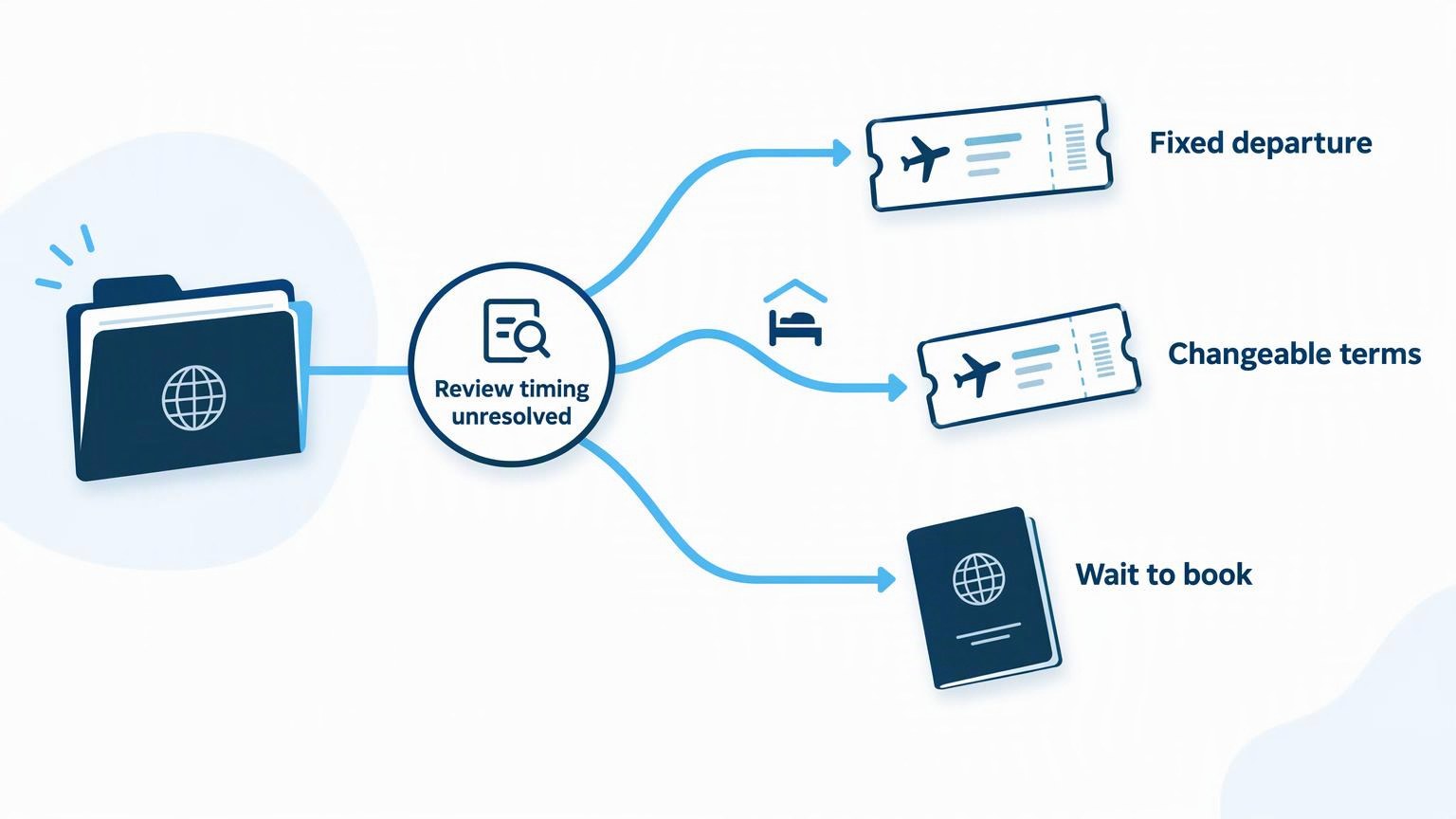
Say you are considering a written plan with a review before departure, but the review date is not settled. One flight option has a fixed departure and restrictive changes; another permits changes under specified terms. You could also postpone booking until the review schedule is clearer.
If the fixed departure could fall before the required review, its attractive fare does not solve the timing problem. A changeable ticket may suit you if you understand its terms and can accommodate a later return. If you cannot extend your time away, postponing commitment may be the better choice.
Next, test lodging continuity and transport for the actual review schedule. Resolve any clinical support requirement with the treating provider; changing a room or flight remains a logistics task. A companion's availability should be compared with the support the care plan actually requires, not an assumed recovery timetable.
Separate change costs, supplier terms and insurance
Supplier terms establish the contractual consequences of a change; insurance policy terms establish whether a covered claim may reimburse an expense. Neither should be inferred from the reason the plan changes.
For example, an additional hotel night remains a lodging service even if the clinician recommends staying for another review. That recommendation does not establish who pays, whether the night is included or which hotel terms apply. If the proposal is silent, you cannot determine those points from it.
Before payment, distinguish what happens if you cancel, the provider postpones surgery or the clinician decides not to proceed after evaluation. Compare deposit treatment, cancellation deadlines, change charges and refund provisions in the applicable clinical and travel agreements. A refund from one supplier does not establish a refund from another.
Review insurance separately for the events and expenses relevant to planned surgery abroad. Cancellation, medical-expense and evacuation coverage answer different questions. Coverage, exclusions, claim conditions and documentation requirements depend on the policy; buying insurance does not rewrite a hotel's or provider's contract.
Keep travel planning and clinical decisions with the appropriate contact
Use a travel-planning conversation for ordinary logistics and the named treating clinician for suitability, procedure choice, recovery instructions and travel clearance. Hospitality Cancun publishes travel and consultation-planning guidance for adults considering Cancun or the Mexican Caribbean; that guidance is not clinical evaluation.
You can prepare your proposal comparison privately. Before submitting any information through Hospitality Cancun's contact section, establish who receives it and for what purpose. Once those details are clear, the first submission is limited to name and email, with optional contact-method preference. It contains no narrative, trip details or attachments.
Travel dates, destination, companions and room needs may be discussed later with the confirmed travel contact. Diagnoses, scans and clinical records belong only in a named provider-confirmed secure channel. Do not send payment details or insurance identifiers through a general inquiry form.
Keep permission to answer your requested inquiry separate from optional marketing and from referral to a specifically named provider. A requested reply is not marketing consent, and a planning conversation does not authorize an introduction.
Frequently Asked Questions
Can before-and-after photos tell me which proposal to choose?
Photos can help you explain an appearance preference during consultation, but they do not identify everything in a care plan or establish your likely result. Use them as discussion material. Judge the proposal through the clinician's explanation, named providers, financial contents and follow-up arrangements rather than images alone.
What if the proposal names an implant brand but no model?
Treat the specification as incomplete for comparison. A brand name alone does not explain the proposed implant's fill, surface, profile or dimensions. Have the treating clinician clarify the intended device and any remaining selection decision. Do not assume another proposal using that brand describes the same implant.
Should I compare a consultation estimate with a final proposal?
You can use an estimate for early budgeting, but label it differently from a proposal issued after evaluation. Identify which clinical or financial decisions remain open. An estimate whose scope is not settled should not be ranked as definitively cheaper than a more complete proposal for specified care.
Does follow-up end when I return to the United States?
Do not equate departure with the end of care. Compare the written arrangements for later reviews, concerns and transfer of relevant records. Identify who would evaluate you after returning home and whether that clinician has agreed to the role. Do not assume local follow-up is automatically available or included.
What if the proposed surgeon or facility changes?
Reassess the replacement rather than transferring your earlier conclusions automatically. Match the new identity and credentials, establish the surgical location, and review any changes to scope, follow-up or terms. Your acceptance of the original proposal does not answer whether the revised arrangement meets the same comparison criteria.