
Consultation planning
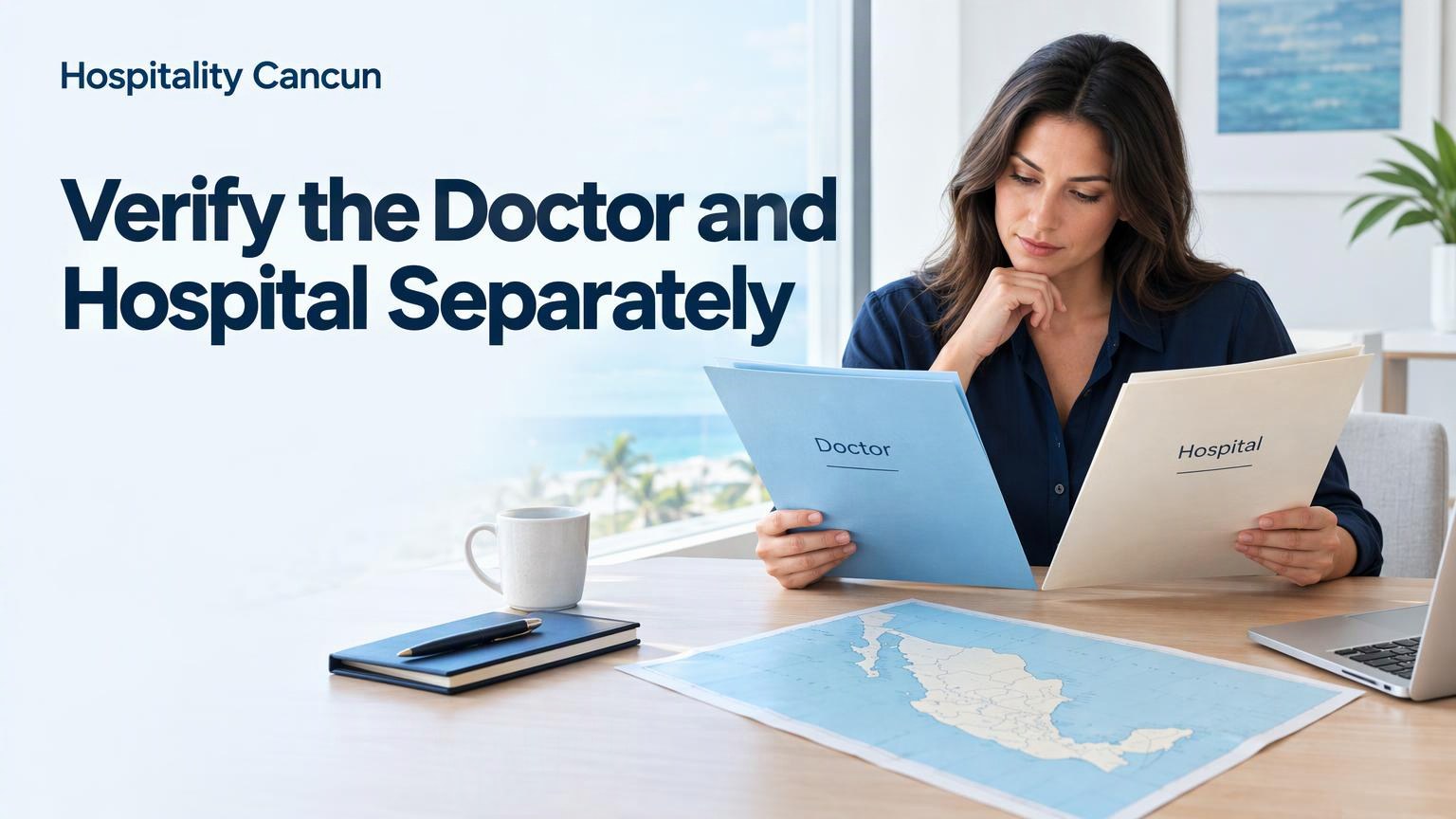
Use separate evidence for the clinician, the facility, and the website that introduced them before you commit to a consultation trip.
Many travelers see a hospital name, a doctor profile, and a coordinator page presented together and assume they have all been vetted together. That presentation alone does not show independent verification of each one. On Hospitality Cancun, our role is travel and consultation-planning guidance for adults considering Cancun or the Mexican Caribbean, not clinical verification on your behalf. Before travel planning becomes useful, you need a clean evidence trail for the clinician who would treat you and the facility where care would occur.
Why verify the doctor and facility separately?
You should verify them separately because they answer different questions. The clinician record helps confirm who the professional is. The facility record helps confirm where care would take place and what organizational status that place currently holds. A website, coordinator, or referral page may introduce both, but it is not proof of either one.
The CDC Yellow Book advises travelers seeking care abroad to assess the treating healthcare professional and the facility separately, and it also warns that accreditation does not guarantee a good outcome. That matters when a page uses one brand story to cover three different actors: the person recommending care, the place providing care, and the site marketing the option. A real consultation choice starts only when each actor has its own supporting evidence.
What information identifies the actual treating professional?
The actual treating professional is the named clinician who will evaluate you, make the clinical recommendation, and, if relevant, perform the procedure or supervise it. Before you compare credentials, you need that person’s full name exactly as used in formal records, the professional role being claimed, and clarity on whether the consultation doctor and the procedure doctor are the same person.
A clinic brand, hospital logo, coordinator name, or a page that says only “our surgeon,” “our specialist,” or “our team” is not enough to identify the treating professional. If messages, invoices, or consultation materials show different names, stop and sort that out first. In practical terms, you are not ready to compare providers until you can point to one specific clinician and say, “this is the person whose independent record I am checking.”
| Evidence source | Useful for | Does not prove | Booking effect |
|---|---|---|---|
| Named clinician with an official professional record | Confirming that a specific individual matches the profession being claimed | That the hospital claim is current, that this is the exact facility of care, or that results will be good | Necessary, but not sufficient on its own |
| Facility certification or accreditation record | Checking whether the hospital or clinic holds the status it claims at the organizational level | Who your treating clinician is or whether that clinician is the one making decisions in your case | Useful only when tied to the exact facility and paired with clinician evidence |
| Referral website, coordinator page, or marketing site | Showing who introduced the option and what claims are being made | Independent proof of the clinician, the facility, or the relationship between them | Treat as a lead, not as final verification |
How should independent credential records be read?
Read an independent professional record as an identity and status check first, not as a marketing score. In Mexico, the official Cédula Profesional portal points users to the Registro Nacional de Profesionistas and the consultation of professional licenses. Once you have a clinician’s exact name, compare the official record with the profession being claimed in the consultation materials.
What a cédula can help confirm
A cédula can help you confirm that a named person has an official professional record consistent with the profession they are presenting. That is valuable because it moves you from “a doctor on a website” to a real person with an official professional record you can match against their stated role.
What a cédula does not settle
A cédula does not by itself tell you whether that clinician is the one who will actually treat you, whether the hospital claim is accurate, whether the specialty description on marketing materials is complete, or whether the option is right for your case. It is one piece of evidence. If the name matches but the rest of the chain is still vague, keep verifying.

What can accreditation establish and what can it not?
Accreditation or certification can establish that a facility met a defined organizational standard at a given time, but it cannot replace individual clinician verification. On the official Consejo de Salubridad General page, facility status is separated into materially different categories, including establishments with a current certificate, establishments with a constancia de participación in the certification process, and establishments with revoked status.
That distinction matters. A current certificate is stronger evidence than a general claim that a hospital “participates” or “is in process.” Just as important, even a current facility certificate does not tell you which clinician will treat you, whether your consultation would occur at that exact site, or whether the outcome will be good. Facility evidence is about the organization. It is not a substitute for knowing the individual professional and the exact location tied to your care.
How should unanswered questions affect the booking decision?
Unanswered core questions should change the decision from book now to pause. Missing identity evidence is not a minor detail. If you still do not know the clinician’s exact name, the claimed role, the exact facility, or the current status behind an accreditation claim, you do not yet have a reliable basis for a consultation trip.
The practical rule is simple. Questions about travel convenience can wait until later. Questions about who would treat you and where care would occur cannot. If those remain unresolved, hold off on nonrefundable travel choices and keep the option in the research stage rather than the booking stage.
Worked example: when the safer decision is to wait
Imagine two consultation options. Option A has a polished website, patient coordinator messages, and a hospital logo, but no clearly named treating clinician and no current facility record you can match to the exact site. Option B gives you a specific clinician name that aligns with an official professional record, plus a facility name you can match to a current certification listing. Even before you compare style, price, or convenience, Option B is the stronger basis for planning. Option A might still turn out to be legitimate, but until the missing evidence is resolved, the sound decision is to pause rather than commit.

Frequently Asked Questions
Is a hospital logo on a doctor or coordinator website enough proof?
No. A logo or brand mention may show an association is being claimed, but it does not independently prove the treating clinician’s identity, the exact site of care, or the current facility status behind the claim. Treat it as marketing until it matches separate clinician and facility records.
If I find a cédula, can I stop checking?
No. A cédula is useful because it helps confirm a named professional record, but it does not answer every decision question. You still need to know whether that clinician is the one who will treat you and whether the named facility has the status being advertised.
What if the consultation doctor and the procedure doctor might be different people?
Then you need both identities before you compare options seriously. A consultation may be arranged through one clinician or office while another professional would perform or supervise care later. If the roles are split, verify each named person rather than assuming one set of credentials covers the other.
Does a current facility certificate mean the hospital is right for me?
No. A current facility certificate can strengthen confidence in the organization’s stated status, but it does not decide suitability, continuity of care, or the strength of the individual clinician choice. It is an important piece of evidence, not a complete answer to the whole decision.
When does travel-planning help become useful in this process?
Travel-planning help becomes useful after you have independently identified the clinician and the facility you are considering. At that point, logistics can be planned around a separately confirmed consultation. If those basics are still unclear, more travel planning will not fix the underlying verification problem.