
Facility Information Guide
Measure the hospital's published information against the specific evidence your consultation and travel decisions require.
A hospital page can be detailed without answering the question that matters most to you. The useful comparison is between what it actually says and what you need to decide, not between promotional descriptions. This guide separates a promising starting point from information that supports a specific commitment.
Is the published information enough to keep Costamed Cozumel under consideration?
Yes, if the relevant specialty or service appears, the page gives you a reason to investigate further. It does not, by itself, give you a reason to choose a particular clinician or purchase travel.
The official Costamed Cozumel page lists specialties including cardiology, orthopedics and traumatology, and general surgery. Its service directory includes laboratory, radiology and imaging, and an intensive care unit. These are concrete navigation leads, rather than evidence that each service is available for your requested appointment.
Compare the information against your nonnegotiable requirement. If you are exploring which specialty to consult, a directory may answer enough for the next step. If your decision depends on a named physician or a particular service arrangement, you need evidence addressing that point.
Keep alternatives open when the available information does not answer a decisive question. An unanswered question is not proof that a facility cannot meet your requirement, but it is not a basis for assuming that it can.
How do you search the Cozumel information efficiently?
Start with the facility-specific page, find the specialty relevant to your consultation, and then trace the related service information. This keeps a broad medical-group description from standing in for Cozumel-specific details.
Use the page heading to establish that you are reading about Cozumel. Then use your browser's find function for the specialty name. Search related terminology only to locate information, not to decide which specialty or treatment you need.
The Cozumel specialty directory includes separate headings for telemedicine and in-person physicians. That distinction matters: finding a specialty name does not necessarily tell you how your consultation would happen. The page also lists Patient's Guide and Visitor's Guide categories, which are separate from its clinical directory.
Let each result determine the next task. A specialty match leads to clinician and consultation-format clarification. A service-category match leads to the service's conditions. A missing match calls for a targeted clarification rather than an assumption that a group-wide offering applies at this facility.
| Information route | Use it when | What it contributes | Limit |
|---|---|---|---|
| Cozumel facility page | You are deciding whether further investigation is worthwhile | Facility-specific specialty and service listings | Not a case-specific commitment |
| Medical-group overview | You want broader organizational context | Background that may guide further searching | Offerings may not apply to Cozumel |
| Named provider's confirmation | Your choice depends on a clinician or consultation format | Evidence addressing your decisive requirement | Does not settle separate travel contracts |
| Another facility's own information | You still lack an answer about a decisive requirement | A comparable basis for keeping alternatives open | Must be evaluated against the same requirement |
What credential evidence applies to the facility and to your clinician?
Facility credentials and individual clinician qualifications answer different questions. Neither should be used as a substitute for the other, and promotional language is not credential documentation.
For a facility credential, match the exact facility name, the issuing organization, the scope, and the current validity period. A historical recognition or renewal statement does not establish present status. Likewise, a claim about a hospital network should not automatically be assigned to the Cozumel facility.
For a clinician, the useful evidence concerns the named person: relevant professional registration, specialty qualifications, and authorization to provide the proposed service at the facility. A specialty directory cannot establish those facts for an unnamed physician.
Apply a simple interpretation rule: identify who holds the credential and what activity it covers. If either is unclear, the claim cannot resolve your selection question. Even complete credential information does not determine whether treatment is suitable for you. Eligibility, diagnosis, treatment selection, and recovery advice remain decisions for the qualified treating clinician.

How can consultation format change your travel decision?
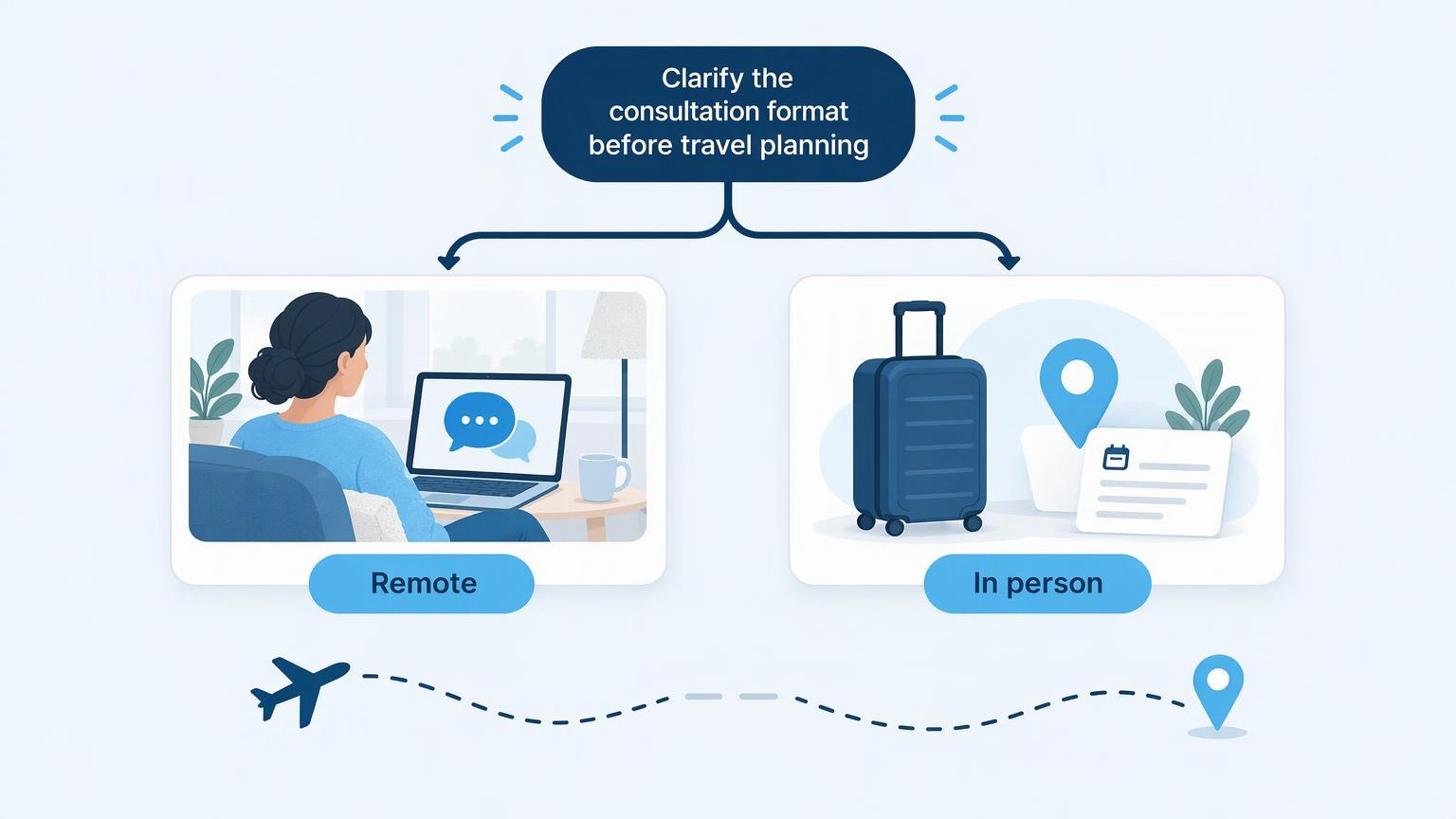
If you do not know whether a consultation would be remote or in person, you cannot yet decide whether it requires travel. Resolve the format before treating a listed specialty as an appointment you can build a trip around.
Say you are considering an orthopedic consultation and want to understand your options before purchasing a flight. You find orthopedics and traumatology in the Cozumel directory, but you do not yet have a named clinician or a confirmed consultation format.
A remote first consultation, if the provider offers it and considers it appropriate, could allow the consultation to happen before travel. An in-person consultation would instead require a confirmed location and appointment before an itinerary could be evaluated. The directory alone does not settle which path is available to you.
The reasoned next step is to establish the format, not guess at a stay length. Once an in-person visit is confirmed, ordinary travel arrangements can be planned around it. Any clinical requirements for follow-up or fitness to fly must come from the treating clinician, not from a general facility description.
Do payment and insurance listings tell you what you would owe?
No. Payment Methods and Insurance Carriers are useful directory categories, but their presence does not establish an accepted payment method for your service, your insurer's coverage, or your personal financial responsibility.
A meaningful financial comparison begins with the service being charged. A consultation, a diagnostic test, and a facility charge are different items; a general statement about payment cannot show whether all are included in an estimate.
Keep your private comparison notes compact: service and exclusions, charging party, payment timing, patient responsibility, and applicable change or cancellation terms. These details belong in the relevant provider or supplier's written terms, not in an inference from a website heading.
If travel changes, distinguish the cause from the charge. A clinician-directed additional hotel night is still a lodging service. That clinical reason does not determine who pays or whether it is included. Supplier change and refund terms govern the booking consequences; any insurance coverage and claim conditions are a separate question.
Who should resolve the remaining clinical and planning questions?
Use the treating provider for clinical questions and a confirmed travel contact for ordinary trip logistics. Our role at Hospitality Cancun is publishing travel and consultation-planning guidance, not determining treatment suitability.
You can prepare a private note identifying the details you still need. Clinical suitability and follow-up requirements belong with the qualified clinician. Travel dates, destination, companions, and room needs may be discussed later with the confirmed travel contact.
Before submitting any information, clarify the recipient and purpose. The first contact submission is limited to name and email, with optional contact-method preference. It does not include a narrative, trip details, attachments, clinical records, insurance identifiers, or payment details.
Permission to reply to your requested inquiry, optional marketing permission, and permission for referral to a specifically named provider are separate choices. A requested reply is not marketing consent. Diagnoses, scans, and clinical records belong only in a named provider-confirmed secure channel. An inquiry also does not establish an accepted referral or a booked appointment.
Frequently Asked Questions
Should a missing detail count against the facility?
Treat it as a question still to be answered, not automatically a negative. A website may omit information that the provider can supply directly. Give the omission more weight when it concerns a requirement that would change your choice. Keep the facility under consideration without making a commitment that depends on the missing answer.
Can reviews replace facility documentation?
No. Reviews may suggest practical issues worth investigating, but they do not establish current professional credentials, service scope, or contractual obligations. A reviewer's visit also may not resemble your proposed consultation. Use experience reports to generate focused questions, then use evidence specific to the facility and service to resolve them.
Does an English-language website establish language support for my visit?
No. English-language information makes the website easier to read, but it does not establish which language your clinician, consent documents, or discharge instructions will use. Treat communication support as a service-specific detail. If it is essential to your consultation, resolve it before relying on the appointment plan.
Does an equipment listing prove a particular procedure is available?
No. An equipment or facility-service listing describes one part of the hospital's published information. It does not establish the necessary clinician, scheduling, procedure scope, or suitability for you. Compare the proposed service itself with the provider's confirmation rather than inferring a complete treatment offering from a single listed resource.
What if two sources give conflicting facility details?
First compare the facility named, publication date, and exact service each source describes. A group profile and a Cozumel page may be discussing different things. If the conflict concerns a decisive requirement, use current documentation or confirmation from the responsible provider rather than choosing whichever description is more reassuring.