

Consultation Planning
Separate hospital-group descriptions from the facility, clinician, service, and travel arrangements that would apply to your visit.
A hospital name can appear on a group website, a location page, a social profile, or a travel intermediary's overview. Those sources answer different questions. A useful comparison connects each claim to a particular facility and visit, rather than assembling an attractive service list from unrelated pages.
Search by facility and service, not the brand alone
Start with the exact facility name and Playa del Carmen, then narrow the search to the service you are considering. Keep results that identify both the location and the relevant service; retain broader group descriptions only as background.
The Gorgeous Getaways Costamed overview explicitly says that not all Costamed locations offer all the services it lists. That qualification matters more for your comparison than a long group-wide treatment menu.
Use a simple sequence: identify the page operator, establish which facility the page describes, and look for the intended service within that facility's information. Then distinguish a general description from a current appointment confirmation. A location-specific result gives you a basis for further discussion; a group-level result does not yet resolve where a visit would happen.
If different pages describe different sites, do not merge them into one imagined facility. Keep the mismatch visible until the provider resolves it. Search prominence, photographs, and a familiar logo do not resolve that mismatch.
Compare the kind of visit each location describes
The meaningful comparison is whether a location's description addresses your intended consultation, testing, procedure, or follow-up. A specialty name alone does not establish which of those steps occurs there.
For example, Costamed's official Puerto Morelos page describes emergency care and patient stabilization. Its official Tulum page describes those functions and also short-stay surgeries. These are descriptions of those facilities, not confirmation of services in Playa del Carmen and not recommendations to choose either location.
The location pages also use separate headings for telemedicine and in-person specialties. That distinction should prompt you to establish how the intended consultation is delivered. Do not assume that a specialty appearing on a page means a clinician will be physically present for your visit.
Use the comparison below to identify which step still needs confirmation. It is not a supplier ranking: the strongest option is the one whose confirmed scope matches the visit you actually need.
| Intended Visit | Information That Supports Comparison | What Still Needs Confirmation |
|---|---|---|
| Consultation only | Named clinician, appointment site, and in-person or remote format | Whether testing or treatment will be recommended |
| Consultation with testing | Confirmed testing site, scheduling sequence, and result-review arrangements | Whether all steps fit the intended trip |
| Procedure with follow-up | Clinician-defined care plan and facility-specific arrangements | Individual suitability, stay length, and clearance to fly |
| Service listed only at group level | Background for identifying the relevant facility | Local availability, delivery format, and appointment acceptance |
Verify the clinician and responsibility for follow-up
Confidence in a facility description should not substitute for identifying the clinician responsible for your care. Establish the clinician's full professional name, relevant qualifications, and role in the proposed visit before relying on an appointment plan.
Compare any credential claim with the issuing institution or professional authority it names. A hospital-group statement about quality or certification is not evidence of an individual clinician's qualifications. Similarly, a biography on an intermediary's page is a starting point for verification, not an independent credential check.
Follow-up has separate parts: delivering a report, interpreting it, and deciding what happens next. A promise to send results does not by itself explain who reviews them with you or handles questions after you return home.
For US English-speaking adults, establish how the consultation and any explanation of consent will be communicated in English. Language assistance can support communication, but diagnosis, treatment suitability, recovery advice, and flight clearance remain decisions for the qualified treating clinician.

Let the confirmed care plan shape travel choices
Choose transport and lodging around a confirmed appointment site and the clinician's follow-up plan, not around a general hospital listing. Search the route only after the destination is settled.
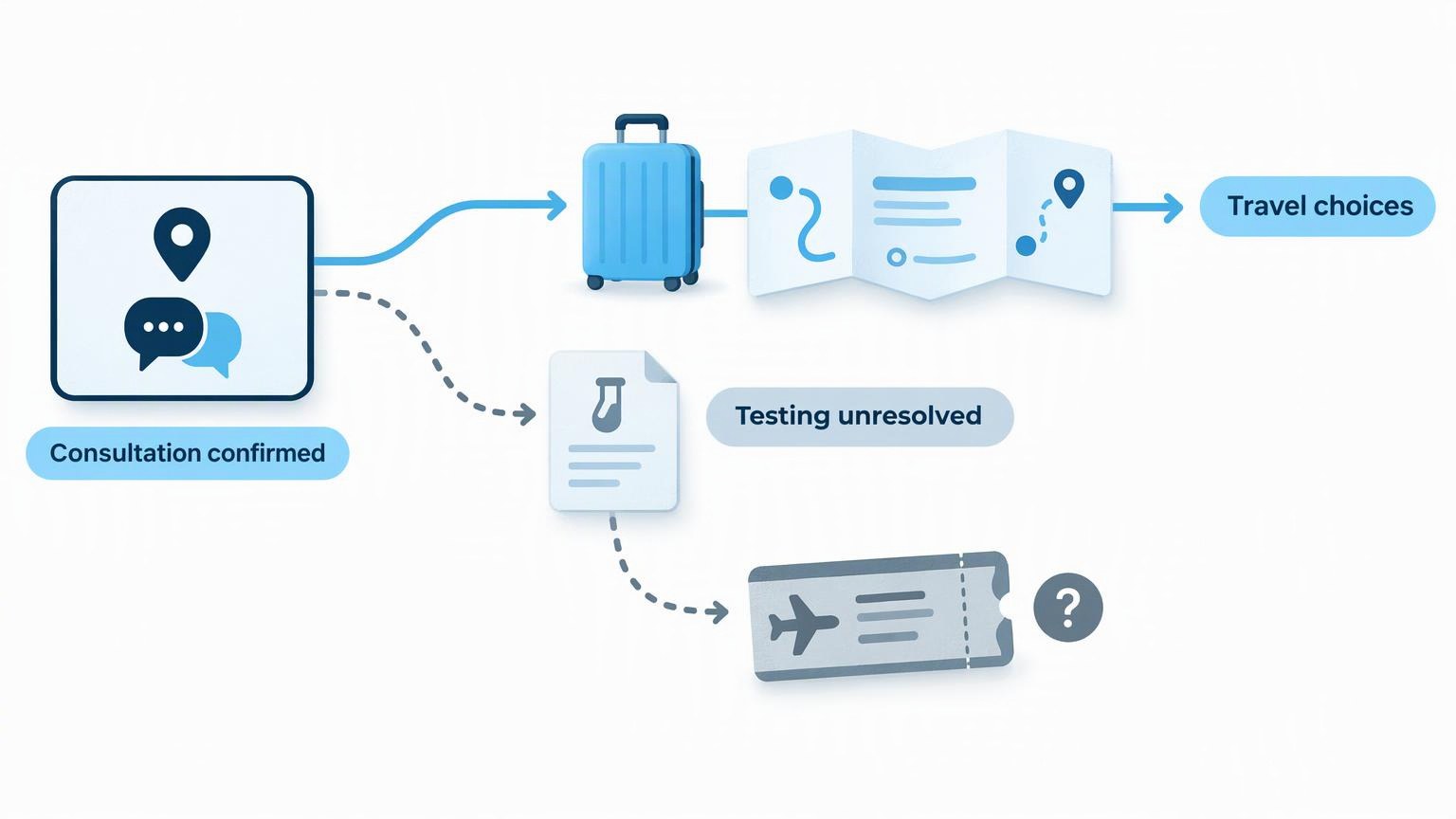
Say you are considering a consultation in Playa del Carmen, but testing timing has not been confirmed. You could buy a fixed return flight on the assumption that everything happens during the consultation, or plan a consultation-only visit and defer any later testing arrangements. If the provider has confirmed only the consultation, the second approach avoids treating unconfirmed testing as part of the itinerary. It may require another trip, but it does not depend on an unsupported same-visit promise.
Once the site is confirmed, compare transport using that exact destination and arrival requirements. Weigh a booked transfer's pickup arrangements against the steps required for an independently arranged journey. Compare lodging by the actual route, room access needs, and cancellation terms rather than an unverified claim of convenience.
A flexible reservation can address travel uncertainty. It does not establish medical clearance to fly or a suitable length of stay.
Compare inclusions and change terms before totals
Compare equivalent services before comparing total prices. A consultation charge, testing charge, and travel arrangement are different purchases even when presented together.
For any proposal you receive, prepare a private comparison with these headings: medical services, clinician or facility charges, travel items, exclusions, payment recipient, and change terms. If an item is not explicitly included, its status needs clarification; do not automatically count it as included or excluded.
If a clinician recommends an extra lodging night, that night remains a travel charge. The clinical reason does not establish who pays, whether it is included, or which hotel terms apply. Those answers depend on the applicable written arrangements.
Supplier cancellation, refund, and change terms determine the consequences under each booking contract. Insurance is separate: coverage depends on the policy's conditions and exclusions, not simply on the fact that a change had a medical cause.
Do not treat an insurance-carrier listing as confirmation of coverage, direct billing, or reimbursement for your visit. Nor should a broad payment-method page establish the payment terms for a particular service.
Separate travel planning from the clinical handoff
Travel logistics belong in a planning conversation; clinical suitability belongs with the qualified treating clinician. Hospitality Cancun publishes travel and consultation-planning guidance. That does not establish a treating-provider or authorized Costamed referral relationship.
Before submitting any information through a general contact form, establish who receives it and the purpose of collection. If either is unclear, clarify it before submitting anything. The first submission allows only your name, email, and optional contact-method preference. It does not include trip details, a narrative, attachments, payment details, or insurance identifiers.
Keep three choices separate: permission to respond to your requested inquiry, optional marketing, and permission for referral to a specifically named provider. A requested reply is not marketing consent.
Later, once the travel recipient and purpose are clear, ordinary travel details can be discussed with that contact. Diagnoses, scans, and clinical records belong only in a named provider-confirmed secure channel. Financial and insurance information are not clinical records; their exclusion from the general form does not establish a later collection channel.
Frequently Asked Questions
Can patient reviews establish whether a service is right for me?
No. A review may describe someone's experience, but it does not establish your eligibility, the proposed clinician's credentials, or current service availability. Even a review naming the same hospital may involve a different clinician or type of visit. Use reviews as context, not clinical or booking confirmation.
Does a medical-tourism label mean flights and lodging are included?
No. The label alone does not identify a package or its contents. Flights, lodging, transfers, medical services, and follow-up may be separate arrangements. Only the applicable proposal and supplier terms establish inclusions. Do not infer a package from destination photographs or a page describing international patients.
Should an old service article be discarded entirely?
Not necessarily. It can help you identify terminology or a service to investigate. Its publication date and scope limit what you can infer about present availability. Keep it as background, while using current facility-specific information and provider confirmation for decisions that commit your money or travel.
Does choosing telemedicine remove the need to identify a facility?
It changes the immediate travel question, but not the need to identify the responsible provider. Establish who conducts the consultation and what it can resolve remotely. If testing or an in-person visit is later recommended, identify that appointment site before arranging travel. A remote consultation is not a complete itinerary.
Can a companion's travel schedule determine when I return home?
A companion's schedule is a logistics consideration, not medical clearance. Compare their availability with the treating clinician's actual care and follow-up plan. A companion leaving earlier may require different transport or lodging arrangements; it does not itself establish a clinical support requirement or make an earlier return suitable.