

Travel and Consultation Planning
Compare the responsibilities behind each arrangement, not just the procedure headline or the promise of an all-inclusive trip.
A package and an independently organized trip can contain the same components yet leave you with different obligations. The useful comparison is who supplies each service, what you can change, and what happens after the procedure. Start with the clinical plan, then compare the travel arrangements that support it.
Choose by responsibility and control, not booking count
A coordinated arrangement is worth considering when its agreement assigns specific tasks you would otherwise manage. Self-planning is a reasonable option when you can organize those tasks and prefer direct control over suppliers. A mixed approach can preserve your preferred flight or lodging while coordinating selected services.
The deciding factor is not how many bookings you have. Separate flight and hotel reservations can be straightforward. A single package with an undefined follow-up location or unclear change policy can leave you responsible for tasks you expected it to cover.
Coordination has value when the agreement identifies who schedules transport, communicates changes, and handles the relevant supplier arrangements. It does not automatically mean one contract, one payee, or clinical support. Independent planning gives you the opportunity to select each reservation's terms, but you remain responsible for making the itinerary work. Use the comparison below to select a route, then test the actual offer against it.
Search for comparable care before comparing packages
Begin with consultation options and provider identity, then narrow the travel offers to the same proposed clinical scope. Comparing unlike procedures produces a misleading package comparison before any travel costs enter the calculation.
For example, PlacidWay's liposuction package listings include combined procedures such as tummy tuck with liposuction. That listing is not an equivalent substitute for a proposal covering liposuction alone.
Search using the procedure under consideration and the destination you are evaluating. Open the provider's own information rather than relying on a listing headline. Identify the proposed surgeon, operating facility, consultation process, and precise procedure scope. Verify claimed professional credentials with the issuing organization and facility claims with the relevant authority, matching the exact person and location.
Let the results change your next step: an unnamed surgeon is not ready for a provider comparison; a combined procedure needs separate clinical discussion; a named provider with a defined scope can move into proposal comparison. Clinical suitability belongs with the qualified treating clinician, not the travel listing.
| Situation | Suitable Route | Reason | Trade-off |
|---|---|---|---|
| You want specified travel tasks handled for you. | Coordinated arrangement | A defined agreement can assign those tasks. | Choices and changes depend on its actual scope and terms. |
| You want direct control and can manage the timetable. | Self-planning | You choose suppliers and reservation terms individually. | You handle scheduling and supplier changes. |
| You prefer your own reservations but want selected tasks coordinated. | Mixed arrangement | Coordination can be limited to agreed components. | Responsibilities at the boundaries must be explicit. |

Compare complete proposals before paying deposits
Compare a package total with a complete independently assembled plan, not with a surgery-only figure. Keep clinical services, travel purchases, and coordination charges separate so that an omission does not look like a saving.
Use one compact scope checklist for both routes:
- Clinical scope: procedure, anesthesia, facility charges, and clinician-specified follow-up.
- Travel scope: lodging, transport, and any coordination service actually included.
- Payment: contracting party, payee, currency, deposit, balance, and payment deadlines.
- Changes: cancellation, rescheduling, refunds, extensions, and who handles each supplier.
- Unplanned costs: which charges are included, excluded, or still unspecified.
The useful sequence is consultation, defined scope, written proposal, review of applicable terms, then a payment decision. Do not treat an initial advertised amount as a final commitment.
Supplier terms determine the contractual consequence of cancellation or a changed booking. Insurance is separate: examine whether the actual policy covers cancellation, medical complications, or evacuation related to the planned trip, including exclusions and claim conditions. Insurance does not rewrite a hotel's refund policy or establish that a package provider must pay an additional expense.
A changed return plan shows which flexibility matters
When the timetable changes, the better arrangement is the one whose terms and practical options accommodate that change, not necessarily the one labeled a package.
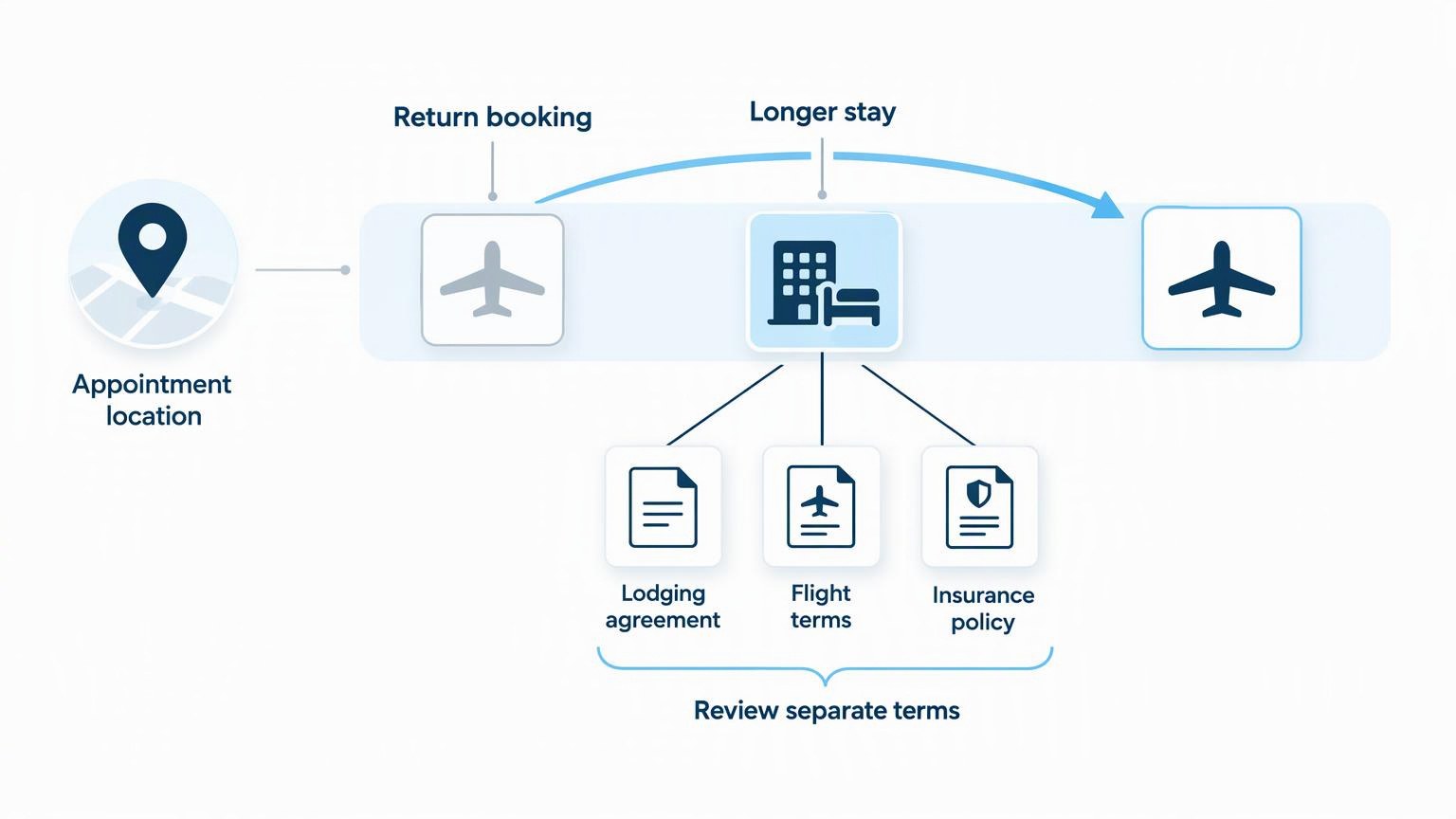
Say you have a proposed follow-up timetable, but the treating clinician later advises staying longer. You are comparing a package with a fixed lodging period against independently booked lodging and a flight whose change terms you have reviewed.
The additional hotel stay is still a lodging service, even though clinical advice caused the extension. The clinician's recommendation does not establish whether it is included, who pays, which hotel terms apply, or whether insurance covers it. Only the applicable agreements and policy can establish those responsibilities and costs.
If the package leaves extensions undefined while the independent reservations offer workable changes, self-planning may be the clearer choice. If a coordinated proposal explicitly explains extension handling and charges, it may suit someone who wants that administration handled. If neither option accommodates a longer stay, defer the booking decision rather than treating the original departure as fixed.
Build the itinerary around follow-up and the return-home handoff
The treating clinician's follow-up plan should determine the travel framework. A package's lodging period is not individual clearance to fly, and a travel coordinator cannot decide your clinical readiness.
First, establish the consultation and follow-up timetable with the clinician. Next, map the actual appointment locations. Compare lodging by access, room suitability for the clinician's instructions, and extension terms rather than amenities alone. For transport, compare any offered transfers with independently arranged rides using pickup arrangements, scheduling flexibility, and responsibility for missed or changed appointments.
Keep practical assistance distinct from clinical care. A companion or transport contact is not automatically an aftercare professional. If the care plan requires clinical support, identify who provides it and how it is arranged.
Before returning home, establish how follow-up questions reach the treating provider, how records will be transferred appropriately, and what local care arrangements are needed. Obtain the clinician's escalation instructions. Changing a room or flight is a logistics task; a new symptom or question about recovery requires the clinical pathway.
Use travel-planning guidance without assuming a clinical relationship
Hospitality Cancun publishes travel and consultation-planning guidance for adults considering care in Cancun or the Mexican Caribbean. Use that information to organize your comparison, not as proof of a treating-provider relationship, an appointment, or package inclusions.
If you are reviewing Costamed-related information, verify the named provider and proposed arrangements directly. Keep a private list of responsibilities the proposals do not explain for later discussion.
Before submitting any information through the Hospitality Cancun contact section, clarify the recipient and purpose. Once those are clear, the first submission allows only your name and email, with an optional contact-method preference. Travel dates, destination, companion needs, room details, and proposal discussions belong in a later conversation with the confirmed travel contact.
Permission to respond to your requested inquiry, optional marketing, and referral to a specifically named provider are separate choices. A requested reply is not marketing consent. Diagnoses, scans, and clinical records belong only in a named provider-confirmed secure channel. Do not place payment details, insurance numbers, or attachments in a general inquiry.
Frequently Asked Questions
Does an all-inclusive label mean flights are included?
No. The label alone does not establish flight inclusion, lodging duration, transfers, or clinical services. Read the itemized proposal for the particular arrangement. When a component is absent or unclear, mark it as unspecified in your comparison rather than treating it as included or automatically excluded.
Can I keep a hotel reservation I already have?
Potentially, if it works with the appointment locations and clinician's instructions, and the proposed arrangement permits separately booked lodging. Compare keeping it with replacing it, including cancellation exposure and extension options. Do not assume a package total will decrease because you decline one component; its pricing terms must answer that.
Is a higher package price evidence of better care?
Price alone cannot establish clinical quality. A higher total may reflect different procedures, lodging, coordination, or other services. Compare those differences separately from provider credentials and the clinical plan. Equally, a lower total does not establish savings until you account for omitted components and the applicable terms.
What if the consultation does not lead to surgery?
Treat consultation and surgery as distinct commitments when reviewing the proposal. Determine which payments apply to each and what the agreement says if treatment does not proceed. Avoid assuming that travel purchases will be refunded because the clinical plan changes. Each supplier's applicable cancellation terms still needs its own review.
Should sightseeing determine which package I choose?
No. Start with the clinical and follow-up requirements, then decide whether any leisure activity fits the treating clinician's advice. Do not interpret a destination itinerary as recovery guidance. A lodging option that supports appointments and allows necessary changes is more useful than attractions that may not fit your care plan.