

Medical Travel Planning
Turn destination research into a practical comparison of appointment locations, travel responsibilities and the consequences of changing plans.
Medical-travel searches mix provider pages, travel offers and destination descriptions. Separate where care would take place, who makes clinical decisions and how you would travel and stay there. Hospitality Cancun publishes travel and consultation-planning guidance; use this guide to organize your comparison without assuming a particular package is available.
Start Your Search With the Exact Appointment Location
Search for the provider and appointment branch first, then compare travel around that address. References to Cancun, Riviera Maya or Cozumel do not establish where your consultation would occur. Keep these destination labels separate in your notes.
If researching Costamed, search its name with the destination you are considering. Find the provider's own branch information, then identify the clinician and proposed appointment location. A travel website mention does not establish a referral relationship or appointment acceptance.
Next, search lodging and transport using that address. Record the endpoints and travel date for each route estimate. Compare airport-to-lodging and lodging-to-appointment journeys separately. Use the results to narrow your shortlist: accommodation with fewer amenities may be more useful if it avoids an awkward appointment journey. Regional descriptions alone cannot support that comparison.
Choose Coordination Only When It Solves a Defined Task
Arrange travel independently when you understand it and can manage changes yourself. Compare coordination when a specific logistics task needs an owner, such as communicating an appointment-time change to a transport supplier. Responsibility matters more than the number of reservations.
You can connect flights, hotels and transfers yourself. Conversely, one transport booking may be difficult without an established pickup point. Identify the task that help would resolve, then assess any offer against it.
A useful offer names the work, boundaries and charge. Scheduling transport is not clinical assistance; an introduction is not acceptance for care. Do not infer either from coordination. Resolve unclear responsibilities before relying on the offer, or retain control yourself. Hospitality Cancun's planning content does not establish a treating-provider relationship or booking service.
| Situation | Suitable Approach | Reason | Trade-off |
|---|---|---|---|
| Appointment location and travel schedule are settled | Independent arrangements | You can select and manage the reservations directly | You handle supplier communication and changes |
| A schedule change must reach the transport supplier | Independent management or clearly scoped coordination | The communication task needs a named owner | Coordination only helps if that task is included |
| Departure depends on a clinical follow-up decision | Clinician-established timing plus adjustable travel | Travel flexibility cannot resolve clinical clearance | Flexible arrangements may have different costs and terms |
| A coordination offer does not name its responsibilities | Resolve scope before relying on it | The label does not establish booking or clinical duties | You cannot yet compare its value |
Build the Itinerary Around the Open Step
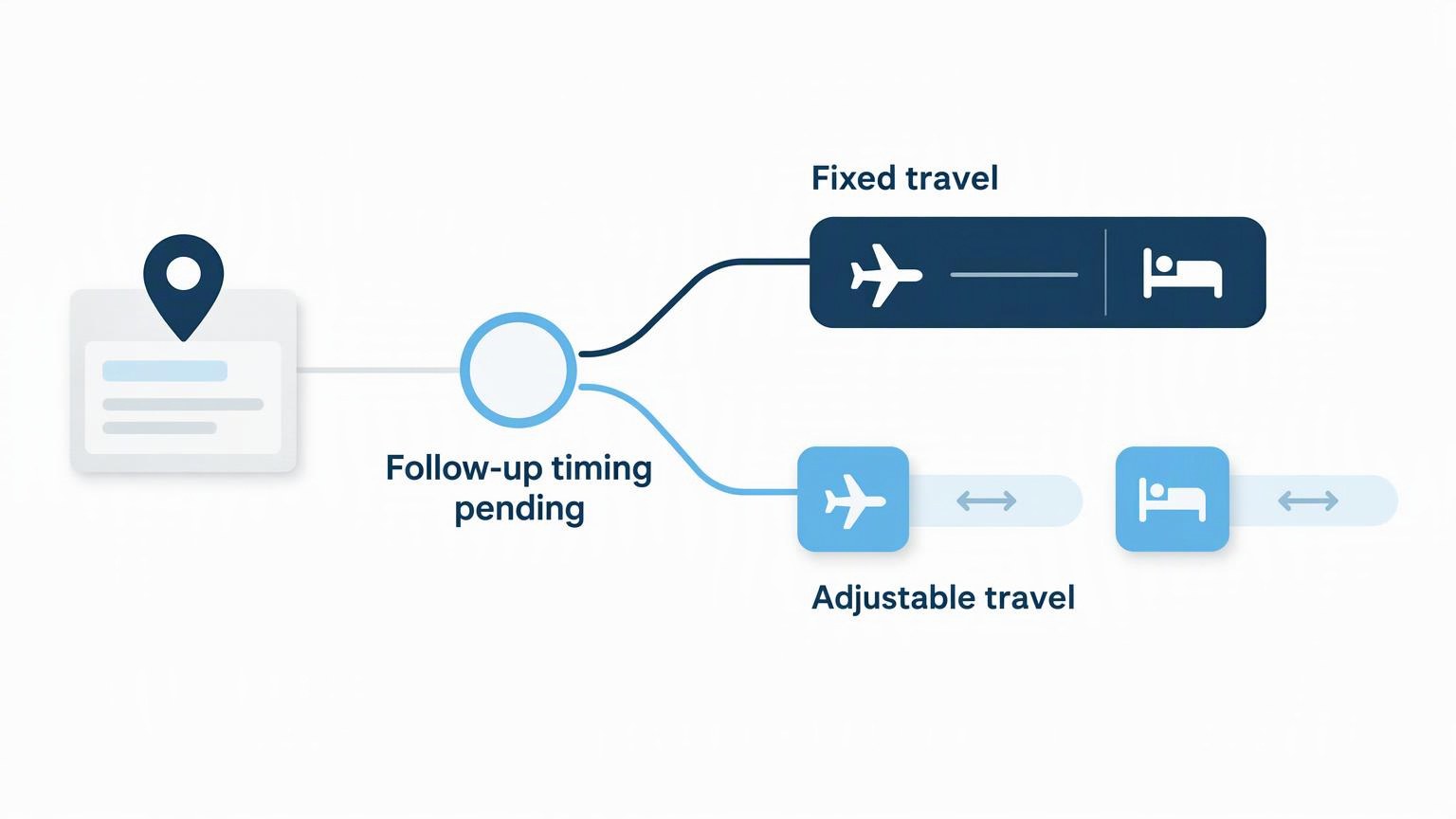
Build the itinerary around the schedule decision still pending. Identify settled appointments before comparing transport and lodging. Flight timing and length of stay depend on the clinician and follow-up plan, not a hotel reservation.
For example, you know the consultation location but not whether the clinician will require an in-person follow-up. Compare a fixed return with adjustable flights and lodging. A fixed itinerary may suit a settled schedule; here, it commits you before departure timing is established. Choose change terms you can accept, or postpone nonrefundable commitments.
Compare private and shared transport where offered. Private transport may give you pickup control; shared transport may suit a timetable you can accommodate. Weigh luggage handling, pickup instructions and cancellation terms alongside price. Follow any clinician-specified transport requirement rather than assuming an ordinary passenger transfer provides medical support. Travel flexibility cannot supply clinical clearance.
Compare the Full Cost and the Consequences of Changes
Compare services before totals. A treatment figure and a travel-inclusive figure are not equivalent; package does not establish lodging, transfers, consultations or follow-up inclusions.
- Named services, quantities and exclusions.
- Supplier, contracting party and payment recipient for each service.
- Currency, deposits and payment milestones.
- Cancellation, refund, rescheduling and no-show terms.
- Responsibility for extra services or an extended stay.
A clinician-advised extra hotel night is still lodging. Its medical cause does not identify who pays, establish inclusion or alter hotel terms. Mark unspecified payment responsibility or applicable terms as not specified, rather than assuming an allocation.
Supplier terms govern booking and payment consequences. Insurance is separate: cancellation, medical and evacuation coverage depend on policy terms, exclusions and claim conditions. Compare what you could owe before a claim decision; expected reimbursement is not available trip funding.
Keep Clinical Decisions With the Treating Clinician
The treating clinician determines eligibility, treatment suitability, recovery guidance and clinical follow-up. A travel contact can use those instructions for later logistics discussions, but should not create them.
Identify the individual clinician and exact facility. Verify claimed professional credentials with the issuing authority. Match any accreditation claim to the facility and current status with the accrediting organization. A logo or hospital-group statement cannot replace checking the entity involved in your care.
Establish who explains consultation findings, how follow-up questions reach the clinical team and what continuity of care is planned after returning home. Clinical records belong only in a named provider-confirmed secure channel.
Translate clinical instructions into appointment locations, attendance requirements and travel restrictions. Flight changes are logistics tasks; new symptoms or questions about fitness to travel belong with the clinician.

Prepare Your Comparison Before a Planning Conversation
Prepare your comparison privately. Before submitting any information through Hospitality Cancun's contact section, clarify the recipient and purpose. If either is unclear, wait rather than sending a smaller message.
The first submission allows only name, email and optional contact-method preference. Recipient confirmation does not expand this list. Exclude dates, destination, companion or room details, narratives, attachments, diagnoses, records, insurance numbers and payment details.
Discuss dates, destinations, companion arrangements and lodging preferences later with the confirmed travel contact. Keep your comparison sheet ready to show viable options and responsibilities still needing an owner. It is preparation for that later conversation, not first-submission content.
Permission to reply to your requested inquiry, optional marketing and referral to a specifically named provider are separate choices. A reply is not marketing consent. Provider introductions require separate permission and do not establish acceptance for care.
Frequently Asked Questions
Can I add sightseeing to a medical-travel visit?
Keep sightseeing separate from appointments. An excursion booking should not set recovery timing or departure. The treating clinician determines whether an activity is appropriate. Compare the activity supplier's cancellation terms before committing, since an optional outing may conflict with the eventual care plan.
Does an English-language website guarantee an English consultation?
No. Website language does not establish the language of consultations, consent documents or follow-up. Establish those arrangements with the provider. If interpretation is proposed, clarify its role and availability before relying on it for an informed clinical discussion or consent.
Should I assume I need a companion?
No. Required assistance depends on the treating clinician and care plan. You may separately prefer company for ordinary travel. Once support requirements are established, compare room occupancy and transport arrangements. Do not assume a companion's room, meals or travel are included.
Does a consultation mean treatment will happen on the same visit?
No. Consultation is assessment, not promised treatment or eligibility. Plan around the appointment actually established. If treatment remains undecided, do not treat a proposed treatment date as confirmed or buy travel arrangements that only work if treatment proceeds on that visit.
Is a refundable booking the same as a changeable booking?
No. Refundability concerns returning payment under specified conditions; changeability concerns modifying a reservation. Read the actual terms: changes may involve price differences or restrictions. An adjustable booking does not guarantee a replacement room or flight will be available when you need it.