

Consultation and Travel Planning
Learn how to distinguish a complete proposal from an attractive headline before committing to care-related travel.
A useful comparison puts proposals on the same basis. An estimate for one treatment scope should not compete directly with a quote covering different services. Hospitality Cancun publishes travel and consultation-planning guidance; treatment eligibility, recommendations and recovery instructions belong with the qualified treating clinician. This guide helps you organize the decision without choosing a procedure for you.
Compare bundled and separate plans on their actual terms
An itemized bundle can be worth considering when its clinical scope, travel services and supplier responsibilities are clear. Separately arranged services can be equally practical when you can align the bookings with the care plan. Reject the idea that either format is automatically more complete.
Start by separating the proposal into clinical services, travel services and optional additions. Mark each as included, separately priced or not yet specified. Treat an omission as missing information, not as a free inclusion. Then compare the alternatives below against your own scheduling needs.
A hotel reservation and a flight can be straightforward to manage independently. Conversely, a single package can be difficult to assess if its departure assumptions conflict with a pending clinical review. The important distinction is whether the bookings allow for that review, not the number of reservations.
Do not rank totals until you can identify what each proposal purchases. A clearly described separate booking may be more useful than a bundle that leaves responsibility unclear.
Verify the named provider before treating credentials as evidence
Begin with the clinician's exact professional identity and the facility where the proposed procedure would take place. A destination's reputation or a coordinator's description does not establish either person's qualifications or a facility's status.
Use a sequence: identify the professional registration and specialty credentials being claimed, identify the issuing or certifying organizations, and check those claims directly with those organizations. Match the name and specialty to the clinician in your proposal. If a result is missing or ambiguous, resolve the mismatch rather than relying on a similar name.
Apply the same approach to any facility accreditation claim: establish the exact facility, accrediting organization and scope of the claim. A credential held by one clinician or facility should not be treated as covering another.
The result changes your next decision. Matching evidence supports moving to consultation and scope comparison, but does not guarantee an outcome. Identity or credential claims you cannot verify are a reason to pause financial commitment, not merely add another question to a travel itinerary.
| Alternative | Choose When | Trade-Off |
|---|---|---|
| Itemized bundle | Scope, suppliers, inclusions and extension terms are clear. | Convenience may come with linked cancellation or change conditions. |
| Separately arranged services | You can match travel bookings to the care plan and compare each supplier's terms. | You manage separate payments and booking changes. |
| Headline offer with missing details | Use only as a starting point for research, not a basis for payment. | The total cannot yet be compared fairly with complete proposals. |

Let the consultation define what the quote is comparing
The treating clinician should define whether liposuction is appropriate for you and explain the proposed approach, alternatives and follow-up. A preliminary estimate can help organize research, but it should not stand in for that assessment.
During a clinical consultation, distinguish what is recommended from what still depends on further assessment. If proposals differ, find out whether the difference reflects your assessment, treatment extent, an additional procedure or simply different billing descriptions. Do not select the larger treatment scope because it appears to offer more for the money.
Keep this compact comparison checklist privately, then use it in the appropriate later consultation or proposal discussion:
- The clinician's recommendation, alternatives and suitability questions that still need answers.
- The exact proposed treatment scope and whether any additional procedure is separate.
- The proposed anesthesia arrangements and procedure facility.
- Required assessments and the point when the plan becomes final.
- Follow-up reviews, support requirements and the decision process for return travel.
Ask for explanations you can understand. If you cannot explain why the scopes differ, the totals are not yet a meaningful comparison.
Separate quoted services, supplier terms and insurance
A usable quote identifies the services being purchased, their suppliers and the conditions attached to payment. Its total is only part of the decision.
After the clinical scope is defined, compare itemized charges for the procedure, anesthesia, facility, assessments, medications and follow-up as applicable. Separately identify lodging, transportation and optional travel services. These are comparison categories, not assumed inclusions.
Before payment, establish the contractual supplier and payment recipient for each service, the currency, payment schedule and which amounts remain estimates. Read what happens if you cancel, the provider cancels, the clinical recommendation changes or travel dates move. Supplier terms should explain any applicable refund, credit, change charge or nonrefundable amount. Do not assume a medical reason overrides those terms.
Insurance is a separate contract. Compare cancellation, medical and evacuation coverage against the actual policy wording, exclusions and claim conditions. A supplier's refusal to refund does not establish insurance coverage, and a policy does not itself change the supplier's obligations. Until the applicable terms answer those questions, you cannot determine who must pay.
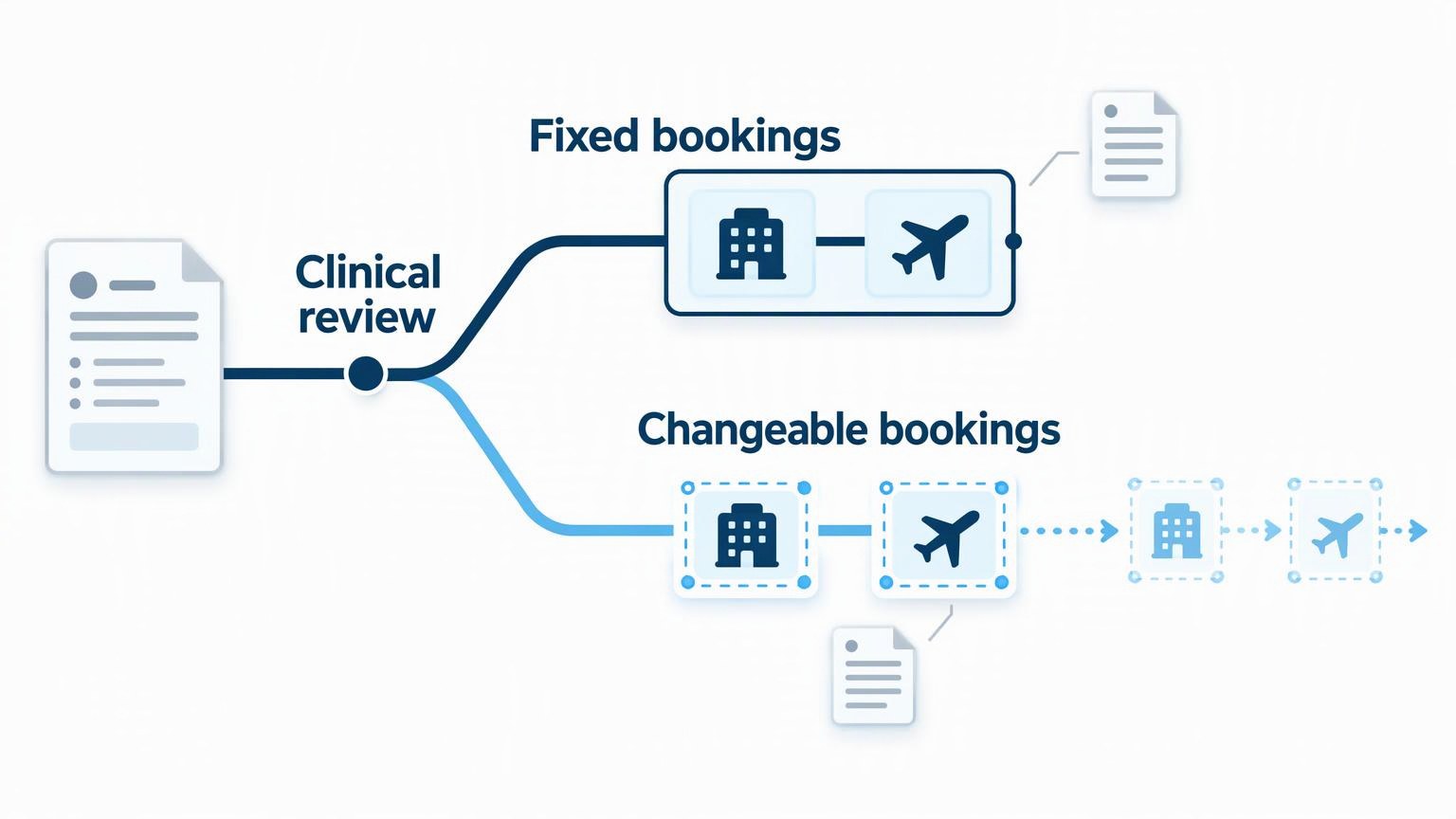
Choose travel flexibility around an uncertain departure
When departure depends on a clinical review, compare the consequences of changing travel rather than assuming the advertised stay is enough. Length of stay and clearance to fly depend on the treating clinician and follow-up plan.
Say you are comparing an itemized bundle with a fixed hotel checkout and return flight against separately arranged lodging and a changeable flight. Both proposals cover the same clinician-defined scope, but the final departure decision comes after a review.
If the clinician advises staying longer, the extra hotel night remains a travel service. The clinical reason does not establish whether it is included, who pays, whether a room is available or whether insurance covers it. Those answers come from the applicable supplier, contract and policy terms.
If the bundle does not explain extensions while the separate arrangements have acceptable change terms, the separate route is the more workable choice. If the bundle clearly addresses those changes and its terms suit you, it may remain competitive. Neither choice replaces the clinical review. The booking decision follows from flexibility and cost responsibility, not presumed recovery speed.
Arrange the clinical handoff before returning home
A follow-up plan should identify who remains responsible for clinical questions during the stay and how care continues after you return home. A travel contact cannot replace that clinical responsibility.
Compare the scheduled reviews, their location or format, the clinician responsible and any separately charged appointments. Establish how the treating team wants you to seek help for concerns, including urgent concerns, rather than assuming routine messaging provides emergency care.
Where home-country follow-up is needed, arrange it with a receiving clinician before relying on it. Determine what that clinician has agreed to provide and what records are needed. Do not assume an introduction means the receiving clinician has accepted responsibility.
Keep the travel handoff distinct: flight changes, room extensions and ordinary transportation arrangements are logistics tasks. Assistance with those tasks is not evidence of nursing or medical support. Any clinical support requirements must come from the care plan.
A proposal is more actionable when its follow-up pathway extends beyond checkout. If responsibility ends at departure without an adequate continuing plan, resolve that gap before committing to travel.
Frequently Asked Questions
What belongs in a first Hospitality Cancun inquiry?
Clarify the recipient and purpose before submitting any information. The first submission allows only name, email and optional contact-method preference. Travel details may be discussed later with the confirmed travel contact. Do not include a narrative, proposals, diagnoses, records, attachments, payment details or insurance numbers in a general form.
Does permission to reply also permit marketing or a referral?
No. Permission to respond to your requested inquiry, optional marketing and referral to a specifically named provider are separate choices. A planning conversation does not establish marketing consent or referral permission. Clinical records belong only in a secure channel confirmed by the named provider, not a general travel inquiry.
Can before-and-after photos replace a consultation?
No. Photos cannot establish your eligibility, the appropriate treatment scope or your follow-up needs. Use them to identify questions about expectations for the clinician, not to predict your result. They also do not replace independent checks of the named provider or establish what a quoted package includes.
Should I compare a Mexico proposal with a local consultation?
A local consultation can provide another clinical opinion and a non-travel alternative. Compare the actual recommendations and follow-up arrangements rather than assuming identical treatment from similar labels. Include travel obligations when evaluating the Mexico proposal, but do not assume either location will be cheaper or more suitable for you.
What if a companion can only stay for part of the visit?
Separate their availability from the clinician's support requirements. A companion's departure does not establish that clinical assistance is needed, but it may conflict with the actual care plan. Resolve that conflict with the treating clinician, then arrange appropriate travel logistics. Do not assume a hotel stay supplies care.