

Care-Team Verification
Evaluate the people, operating location and follow-up responsibilities behind a proposed procedure before letting a travel package drive your choice.
A mommy makeover is a package name, not a complete treatment specification. PlacidWay's Cancun guide describes it as a personalized combination of cosmetic procedures. Your evaluation therefore needs to follow the actual proposed care, not the headline. This guide helps you organize that evaluation without endorsing a surgeon or deciding whether surgery is appropriate for you.
Identify the people behind the procedure
Start with named people and an itemized procedure outline. An offer that identifies only a coordinator or clinic brand is not yet detailed enough to evaluate the care team.
Separate the operating surgeon, anesthesia professional, operating facility and clinician responsible for postoperative care. Record each person's full professional name and role in your private comparison notes. A travel contact may discuss logistics, but that role should not be confused with responsibility for clinical assessment or treatment.
The procedure outline should also distinguish what you are considering from what a clinician has recommended. If an advertisement mentions abdominal and breast procedures, do not assume both are appropriate or will happen together. That decision belongs in your clinical assessment.
This first step creates a usable research starting point: identifiable clinicians tied to specific responsibilities. If names or roles change later, revisit the affected checks rather than assuming that information about the original team carries over.
Check credentials against the named clinician
Investigate a credential through its issuing organization, then match the result to the clinician you would actually see. A badge on a sales page is a claim to investigate, not the completed check.
First, obtain the exact credential title, issuing organization and identifier where one exists. Search the clinician's full professional name together with that organization. Navigate to the issuer's own website independently instead of relying only on a screenshot or a link supplied by a seller.
If the issuer offers a directory, compare the name, specialty, identifier and any stated status or validity information. Read what the credential actually covers. A membership listing should not be interpreted as a different qualification, and a record for another specialty does not answer the same question.
When a search returns no clear match, distinguish uncertainty from a negative finding. Spelling differences or incomplete public records may need clarification with the issuer. If a mismatch remains unexplained, pause selection rather than overlooking it.
| Finding | Next Step | What It Means |
|---|---|---|
| Issuer record matches the clinician and claimed credential | Continue to facility and consultation checks | Supports that specific credential claim, not a promised outcome |
| Record is incomplete or the name differs | Resolve the identity with the issuer | An inconclusive search is not proof of invalidity |
| Credential belongs to another person or covers something different | Pause selection and resolve the discrepancy | The record does not support the claim presented |

Verify the operating site and anesthesia responsibility separately
Check the exact operating location and anesthesia professional separately from the surgeon. An individual's credential does not establish the status of a building or another member of the team.
Use the facility's legal name and operating address, not just a brand name. For any claimed authorization or accreditation, identify the issuing body and match its record or confirmation to that location and scope. A certificate for another address does not resolve the question about your proposed site.
Establish who will assess you for anesthesia and who is responsible during the procedure. The treating team should explain its emergency arrangements, including where care would continue if the original location could not provide what was needed. Do not infer those arrangements from photographs of equipment.
Apply the same distinction to aftercare accommodation. A hotel room, meals or transport are travel services. They do not establish nursing provision or clinical monitoring. If clinical care is offered outside the operating facility, identify who provides it and under whose responsibility.
Test the follow-up plan against your travel limits
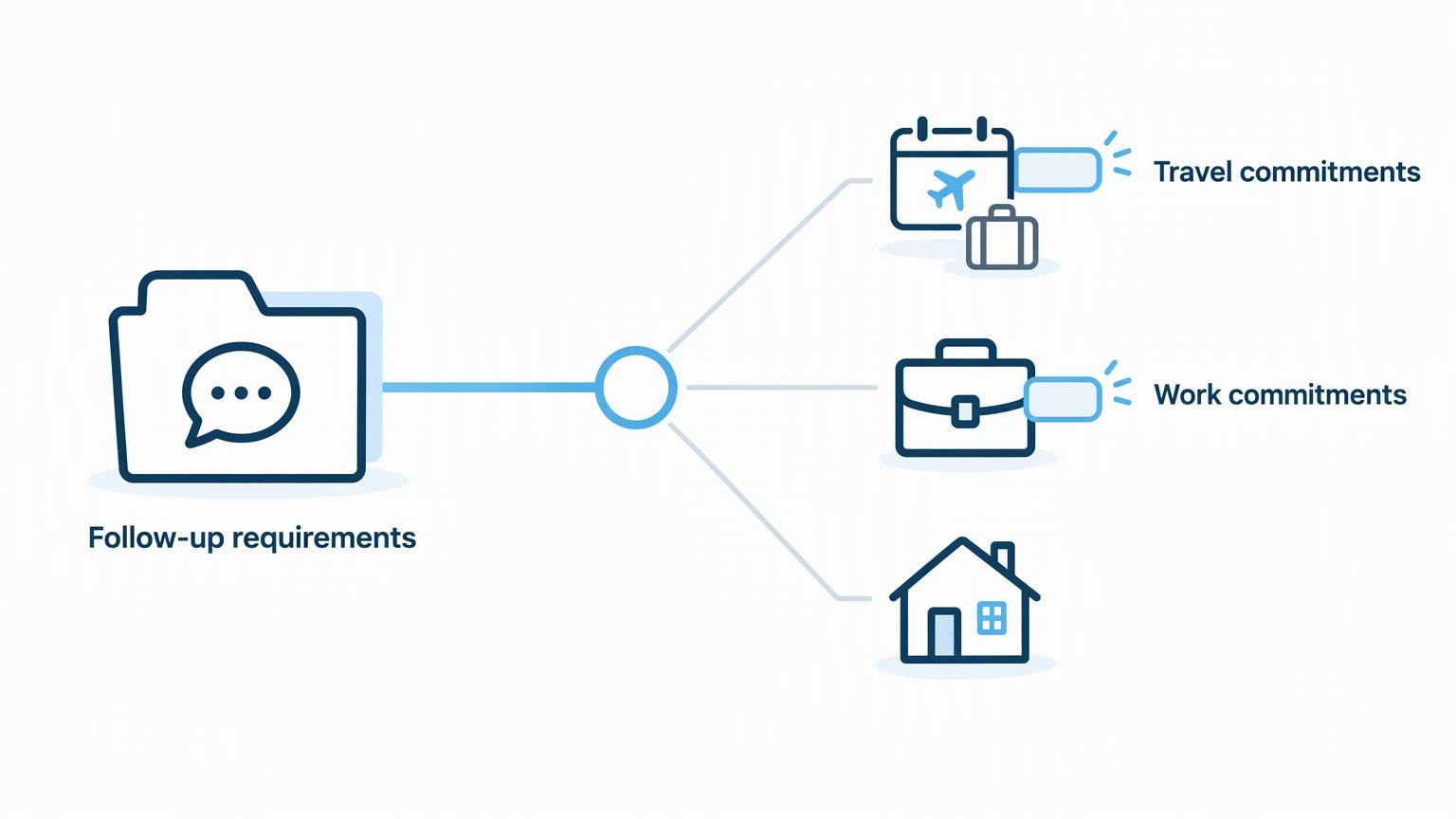
A workable follow-up plan identifies clinical responsibility before departure and after you return home. The clinician's assessment and follow-up requirements must guide travel timing, rather than a fixed package stay being treated as clearance to fly.
Say you have a firm return-to-work date and are comparing an offer with accommodation against a consultation with a named surgeon and a defined follow-up process. The accommodation makes the trip easier to picture, but neither option resolves your deadline until the clinician addresses whether the proposed schedule is suitable.
You could leave travel uncommitted while pursuing that assessment, move the work deadline, or consider care closer to home. If the deadline cannot move and the clinician cannot support the required departure timing, reconsidering the travel plan is more useful than searching for a shorter hotel package.
For ongoing care, distinguish routine review from urgent concerns. Establish who evaluates each, how that person is reached and what arrangements apply after you leave. A virtual check-in should not be assumed to cover every need.
Use the consultation to evaluate the proposed care
A consultation should address your individual options and understanding, not simply confirm that a package can be purchased. Credential verification helps establish who the clinician is; it does not determine whether a particular procedure is suitable for you.
Prepare your goals and questions privately. In the clinical consultation, the qualified treating clinician should assess your circumstances and explain the proposed procedures, relevant risks, limitations and alternatives. Eligibility, diagnosis, treatment suitability and recovery advice remain clinical decisions.
Pay attention to how alternatives are handled. A useful discussion can include not proceeding, changing the scope or considering procedures separately when clinically appropriate. You do not need to choose the most extensive advertised combination.
For an English-speaking adult, understanding also needs to extend beyond the initial sales conversation. Establish how clinical discussions, consent materials and postoperative instructions will be communicated in language you understand. Take any remaining clinical questions to the treating clinician rather than accepting a travel coordinator's reassurance as a substitute.
Separate the travel-planning inquiry from clinical care
Hospitality Cancun publishes travel and consultation-planning guidance. Use its contact section to investigate whether its travel-planning scope fits your intended care, not as evidence of a treating-provider relationship or a confirmed clinical appointment.
Before submitting any information, establish who receives it and for what purpose. If either is unclear, wait. Once both are clear, the first submission permits only your name and email, with an optional contact-method preference. Do not include a trip narrative, dates, destination, companion details or attachments.
Later, ordinary travel details may be discussed with the confirmed travel contact. Diagnoses, scans and medical records belong only in a named provider-confirmed secure channel. Do not send payment details or insurance identifiers through a general inquiry.
Keep three permissions separate: a reply to your requested inquiry, optional marketing, and referral to a specifically named provider. Requesting a reply is not marketing consent or permission for an unspecified referral. Any introduction still leaves you responsible for evaluating the proposed clinical team.
Frequently Asked Questions
Do before-and-after photographs prove a surgeon is qualified?
No. Photographs do not establish identity, credential status or who performed the care shown. They also do not determine what is suitable for you. Treat images as presentation material rather than independent verification, and discuss any expectations they create directly with the clinician during your consultation.
What if the proposed surgeon changes after my consultation?
Do not transfer your conclusions automatically to the replacement. Verify the new clinician's identity and claimed credentials, then establish whether the clinical assessment, proposed procedures and follow-up responsibilities remain applicable. If you have already entered an agreement, review its actual substitution and cancellation terms rather than assuming a refund right.
Does a personal recommendation replace independent checks?
No. A recommendation can help you identify someone to research, but another person's experience does not establish current credentials, the operating location for your care or your suitability. Use it as a starting point, then evaluate the named team and your own proposed treatment through the same process.
Can I treat a deposit request as proof that I have been clinically accepted?
No. A payment request does not establish that a qualified clinician has assessed you or recommended the advertised procedure. Separate the clinical decision from the transaction. Before any payment, understand who the contracting party is and what the applicable written terms say; do not put payment details in a general inquiry.
Is it reasonable to seek another clinical opinion?
Yes. Another opinion can help you examine a recommendation you are unsure about, a proposed combination of procedures or alternatives you do not understand. Arrange that discussion with an independently verified clinician. It is an opportunity for clinical assessment, not a way to compare package labels or obtain a promised result.