

Consultation Planning
Turn a destination search into a focused consultation inquiry without treating a package listing as an appointment offer.
A search result can describe a procedure, a hospital group and a destination without explaining who would actually see you. Your immediate goal is not to choose a surgical package. It is to establish whether there is a relevant consultation to pursue and what decision that appointment would help you make.
Find the actual consultation location before comparing travel
Start by locating the provider's own consultation information and matching it to an exact appointment address. A Cancun label is not enough to establish where an evaluation would happen.
For example, PlacidWay's Playa Del Carmen package page includes a listing titled “Rhinoplasty Package in Cancun, Mexico by Costamed.” The same listing uses multiple destination labels. That tells you the advertised geography is broader than a single appointment location; it does not confirm a Cancun consultation.
Search next using the named provider or hospital group, “rhinoplasty consultation,” and the destination you are investigating. Prefer the provider's appointment information over another package summary. Then distinguish the consultation address from any proposed surgical facility.
If the result identifies only a hospital group, the next task is to identify the relevant clinician and site. If it identifies a consultation address, you can begin comparing travel to that address. If no appointment location emerges, keep researching rather than choosing lodging around the search title.
Identify who would evaluate you and what the visit would cover
A useful consultation arrangement names the clinician responsible for evaluation and explains whether the interaction is clinical or administrative. A conversation about travel, scheduling or advertised packages is not a substitute for that evaluation.
Obtain the clinician's full professional name and the credentials relevant to the proposed work. Compare any claimed license or specialty certification with the issuing authority's record, matching the person and specialty rather than relying on a logo or hospital affiliation. An unexplained “certified” label leaves the credential question open.
Privately prepare the concerns you want to discuss: appearance, breathing, prior nasal surgery or a combination. The qualified clinician should determine how those concerns need to be evaluated, whether another specialist is appropriate and what can reasonably be addressed.
The important distinction is between an appointment that helps establish a medical plan and an administrative exchange that helps arrange one. Both can have a purpose, but only the treating clinician can advise on diagnosis, treatment suitability and an individual recovery plan.
| Interaction | Suitable when | Trade-off |
|---|---|---|
| Administrative discussion | You need to understand location, scheduling or the appointment process. | Does not resolve clinical suitability. |
| Provider-confirmed remote consultation | The clinician can address your immediate evaluation questions remotely. | Some conclusions may require an examination. |
| In-person consultation | The clinician identifies a reason for an examination before further decisions. | Requires travel without establishing a commitment to surgery. |

Choose a consultation format that answers your next question
Investigate a remote consultation when your immediate need is to understand the provider's evaluation process without committing to travel. Consider an in-person consultation when the clinician says an examination is needed for the decision you want to make. Confirm that either format is actually offered.
PlacidWay's package guide describes virtual consultations and in-person surgical assessments as package components. That is the publisher's description, not confirmation that a particular provider offers those steps to you.
For a remote appointment, establish whether you will speak with the evaluating clinician or an administrative representative, and which conclusions would need an in-person examination before the clinician could confirm them. For an in-person visit, establish its purpose and whether it is separate from a surgical admission.
Choose by the question the appointment can resolve, not simply by convenience. A remote administrative discussion may clarify scheduling but leave clinical questions untouched. An in-person consultation may be worthwhile without committing you to treatment.
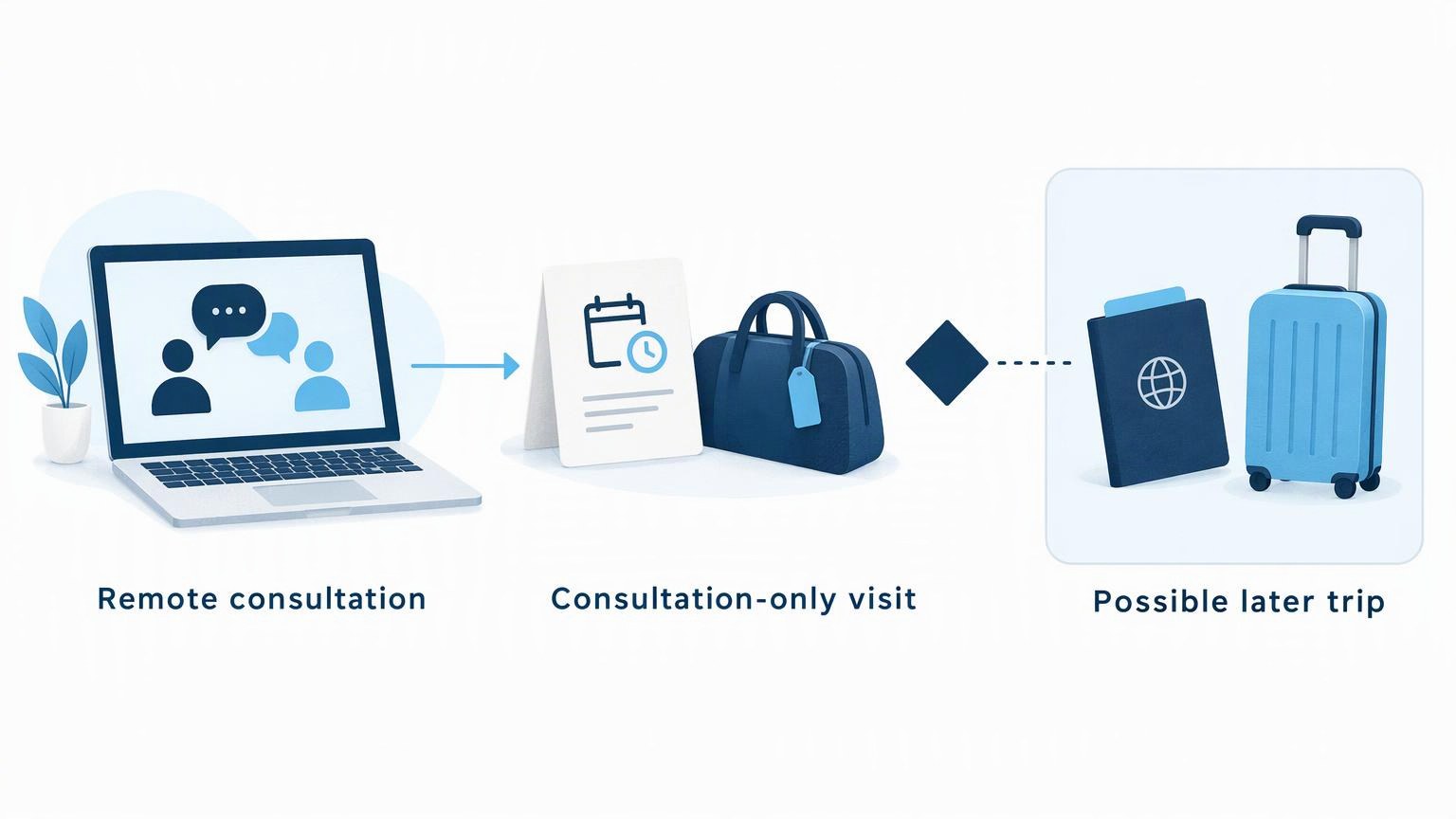
Separate consultation travel from a possible surgery trip
Do not build a surgery itinerary around an evaluation that has not established suitability or follow-up needs. A consultation-only trip and a combined consultation-and-treatment trip involve different commitments.
Say you have limited time away from work and want both an appearance concern and a breathing concern evaluated. You find a package but do not yet know who will assess both concerns. Traveling with surgery assumed could leave you holding reservations for a plan the clinician changes or does not recommend.
A provider-confirmed remote consultation may be the more useful first step if it can clarify the evaluation route. If the clinician requires an examination, a consultation-only visit lets you make the treatment decision afterward. A combined trip becomes worth investigating only when the provider explains the assessment sequence, outstanding clinical decisions and follow-up arrangements.
In this example, the reason to separate the trips is that the evaluation has not yet established a treatment plan, not that several reservations are involved. Flight timing and length of stay depend on the clinician's individual plan. Changing a hotel or flight is a logistics task; it does not itself establish a need for clinical support.
Understand what a consultation charge commits you to
Before accepting a charge, distinguish payment for the consultation from a surgery deposit or travel reservation. A package headline does not establish the consultation fee or whether that fee is credited toward later treatment.
Keep one short checklist for the provider's proposed terms:
- The service charged and the party receiving payment.
- What the consultation includes and what requires a separate appointment.
- Whether any credit toward surgery applies, and under what conditions.
- Cancellation, rescheduling and refund terms, including if surgery is not recommended.
If an evaluation changes the plan, apply the relevant supplier's terms separately to each booking. A canceled consultation, a surgery deposit and a hotel reservation are different contractual commitments.
Likewise, an extra hotel night remains a travel charge even when a clinician recommends a longer stay. That recommendation does not determine who pays or whether the night is included. Supplier terms govern booking consequences; insurance coverage and claim conditions are separate. Do not assume insurance overrides a provider's or hotel's cancellation rules.
Prepare a planning conversation without assuming an appointment is offered
Hospitality Cancun publishes travel and consultation-planning guidance. Use a later planning conversation to clarify whether its scope covers your procedure and consultation needs, rather than treating the Hospitality Cancun contact section as a confirmed clinical appointment.
Before submitting any information, clarify who receives it and for what purpose. Once those details are clear, the first submission is limited to name and email, with optional contact-method preference. Do not add a narrative, travel details, records, attachments, insurance identifiers or payment information.
Keep three permissions separate: responding to your requested inquiry, optional marketing and referral to a specifically named provider. Permission for a reply is not marketing consent.
Later, ordinary travel details may be discussed with the confirmed travel contact. Diagnoses, scans and medical records belong only in a named provider-confirmed secure channel. Prepare your consultation questions privately so the later conversation can establish the business's planning role without asking it to decide clinical suitability.
Frequently Asked Questions
Can I ask to have the consultation in English?
Yes. Establish whether the evaluating clinician can discuss your concerns in English and how interpretation would work if needed. An English-language website does not answer that question. You should understand the clinician's explanations and have an opportunity to ask follow-up questions before making a treatment decision.
Should I bring reference photos of the appearance I want?
You can prepare reference images privately as discussion aids, not as a promised result. Ask the clinician how to share them through the appropriate consultation process. Do not attach them to a general inquiry. The clinician should explain whether the changes you have in mind are realistic for you.
Can a companion join the consultation?
Ask the provider whether a companion may attend or join remotely, and decide what you want discussed in their presence. Do not assume access is included. Companion travel arrangements can be discussed later with a confirmed travel contact; they do not belong in the first contact submission.
Do I have to agree to surgery during the consultation?
You can approach the consultation as information gathering rather than a commitment to treatment. Before accepting its terms, establish whether the offer includes any separate surgical deposit or booking commitment. Leave room to review the clinician's explanation and decide whether you want to proceed, pause or seek another opinion.
What if two clinicians suggest different approaches?
Ask each clinician to explain the reasoning, limitations and alternatives behind the recommendation. Differences are not resolved by choosing the cheaper package or preferred visual preview. If the explanations leave you uncertain, consider another qualified clinical opinion before committing to treatment or building a surgery itinerary.