

Medical Travel Planning
Learn which review details help you assess a leave window and which calendar decisions require information beyond a patient's account.
An enthusiastic review can describe a satisfying experience while leaving your main question unanswered: can the proposed trip fit the time you have away from work? This guide focuses on that calendar question, not provider rankings or review authenticity. The goal is to extract useful scheduling information without turning another person's experience into your own medical timetable.
Give Scheduling Details More Weight Than General Praise
For planned time off, a review is more useful when it explains what happened in sequence. Praise for staff, appearance or communication may describe satisfaction, but it does not show when the reviewer attended follow-up, left Tijuana or resumed work.
Look for the procedure described, when the experience occurred, the appointments the person attended and whether plans changed. Then look at what “back to work” means. Answering email at home is not the same task as lifting, prolonged standing or business travel. A review that identifies duties gives you a better comparison than an unexplained return date.
Specificity improves a review's usefulness, not its authority. Even a detailed account remains one person's experience. It cannot establish your treatment suitability, a provider's credentials or your individual clearance to travel.
Use the comparison below to sort accounts by the question they can help answer. You do not need to declare a review good or bad overall. A satisfaction-only account may simply be unsuitable evidence for the leave decision you are making.
Search for a Timeline, Then Narrow the Missing Detail
Start with the exact provider name and the procedure you are considering, then add a scheduling term. This is more useful for your leave decision than searching only for the best plastic surgery reviews in Tijuana.
First, search for accounts mentioning follow-up or departure. Open the full account rather than relying on a search preview. Note whether it identifies an appointment sequence or merely says the person stayed for a certain period. The first result helps you identify a dependency; the second gives you a duration without explaining its purpose.
Next, narrow the unanswered question. If departure is described but work is not, search for return-to-work accounts and read for the duties involved. If the calendar changed, look for an explanation of what changed and how the traveler handled it. Keep separate notes for different procedures and providers rather than combining their timelines.
Stop searching when additional accounts repeat praise without resolving the missing milestone. More reviews do not necessarily supply better scheduling evidence. At that point, mark the question as unanswered and take it into consultation planning instead of averaging unrelated stay lengths.
| Review Content | Useful For | Remaining Limit |
|---|---|---|
| General praise without dates | Understanding the writer's satisfaction | Does not establish a leave timeline |
| Appointment and departure sequence | Identifying milestones to discuss | Does not confirm your own schedule |
| Return to work with duties described | Comparing the demands of the job | Does not establish your work readiness |
| An explained change to the itinerary | Identifying where flexibility mattered | Does not predict your costs or outcome |
Separate Departure, Follow-Up and Work Readiness
A review's dates become useful only after you identify what each date represents. Leaving a facility, leaving Tijuana, arriving home and returning to work are different events. None should silently stand in for another.
Build a private calendar with three tracks: clinical appointments, travel movements and work obligations. Beside each entry, mark whether it comes from a review, your own constraint or guidance from the treating clinician. This prevents a reviewer's experience from appearing as a confirmed appointment or medical instruction in your plan.
For example, an account may describe returning home without saying whether follow-up was completed before departure. That is a gap in the sequence, not evidence that follow-up was unnecessary. An account may also describe working again without identifying reduced hours or changed duties.
Your treating clinician determines the individual clinical plan, including follow-up and guidance on travel and work. Keep questions precise: which appointment must occur before departure, and which work activities need separate discussion? This gives the clinician a concrete calendar issue to address without asking them to endorse a reviewer's timetable.
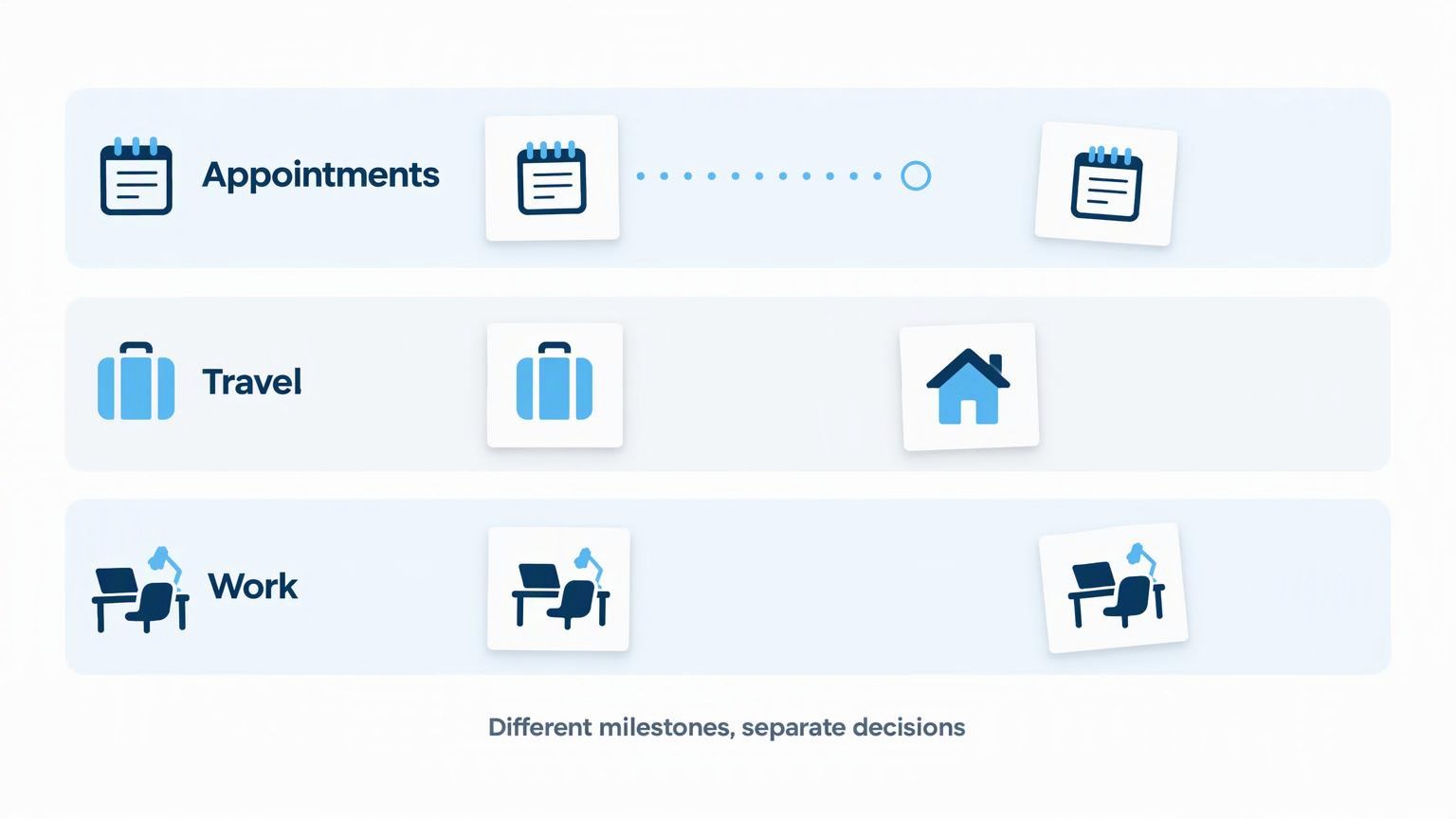
A Fixed Work Deadline Changes What You Can Commit To
If your return-to-work date cannot move, favorable reviews are not enough to justify committing to the trip. The decisive issue is whether the individual care and travel plan fits that deadline, including any follow-up that has not yet been scheduled.
Say you have approved leave with a firm end date. You find a detailed account from someone who returned to work within a similar window, but it does not identify their duties. Your own final follow-up date is still unsettled. You could copy the reviewer's schedule and purchase travel, or keep the window tentative while the treating clinician addresses the missing milestone.
The second choice follows because the review does not resolve your dependency. If the clinician's proposed schedule fits, you can assess transport and lodging against it. If it extends beyond the leave window, the useful alternatives are changing the leave arrangement or postponing the trip, not assuming you will recover faster.
Flexible reservations can reduce the disruption of changing travel plans, but they cannot create clinical clearance or additional time off. A companion's departure or an extendable room is a logistics consideration; any clinical support requirement comes from the actual care plan.

Move Open Questions to the Appropriate Source
Take questions the reviews leave unanswered to the source responsible for each part of your plan. The next step is not another overall rating: it is obtaining the information that controls your calendar.
- Treating clinician: the individual appointment sequence, follow-up, travel guidance and work-related limitations.
- Employer process: leave approval, duties and any documentation requirements.
- Travel suppliers: reservation changes, cancellations, refunds and any extension charges under their actual terms.
Keep these responsibilities separate. If a clinician directs an additional hotel night, the lodging remains a travel service. That direction does not establish who pays or whether the night is included. Supplier terms govern the reservation consequences; insurance coverage depends separately on the applicable policy and claim conditions.
If you are open to another destination, assess its proposed calendar afresh rather than transferring a Tijuana review's timeline. We publish travel and consultation-planning guidance for adults considering Cancun or the Mexican Caribbean. This article does not offer Tijuana services or establish a treating-provider relationship.
Before submitting any information through our contact section, clarify the recipient and purpose. Once clear, the first submission is limited to name, email and optional contact-method preference. Travel details may be discussed later with the confirmed travel contact. Permission for an inquiry reply, optional marketing and referral to a specifically named provider are separate choices.
Frequently Asked Questions
Should I reject an older review?
Not automatically. An older account can help you identify a scheduling question, but it should not establish current appointment arrangements or supplier terms. Note when the experience occurred and whether later updates exist. Use it to frame a question, not to assume the same arrangements still apply.
Are before-and-after photographs useful for this decision?
Photographs do not supply a reliable leave calendar. Even dated images may omit appointments, travel guidance and work demands. For this particular decision, prioritize written descriptions of the sequence and duties. Treatment suitability and the interpretation of medical results belong with the qualified clinician, not a scheduling inference from photographs.
What if two detailed reviews describe different stay lengths?
Keep the accounts separate rather than calculating an average. Compare the procedure described, follow-up sequence, departure circumstances and work duties. If those differ or are missing, the durations are not directly comparable. The disagreement identifies an issue for your individual planning; it does not establish a minimum or maximum stay.
Does a detailed review verify a surgeon's credentials?
No. Scheduling detail and credential verification answer different questions. A patient account can describe an experience but does not authenticate a license, specialty credential or facility status. Verify those claims through the relevant issuing authority for the exact clinician or facility. Do not substitute detailed storytelling for that separate verification.
Can I attach medical records to a travel-planning inquiry?
No. Do not put diagnoses, scans, clinical records, payment details, insurance numbers or attachments in a general inquiry form. Clinical information belongs only in a named provider-confirmed secure channel. Financial and insurance identifiers are not clinical records, and their exclusion from a general form does not establish another collection route.